Español


Prone Yoga Poses: Complete Guide to Prone Yoga Pose
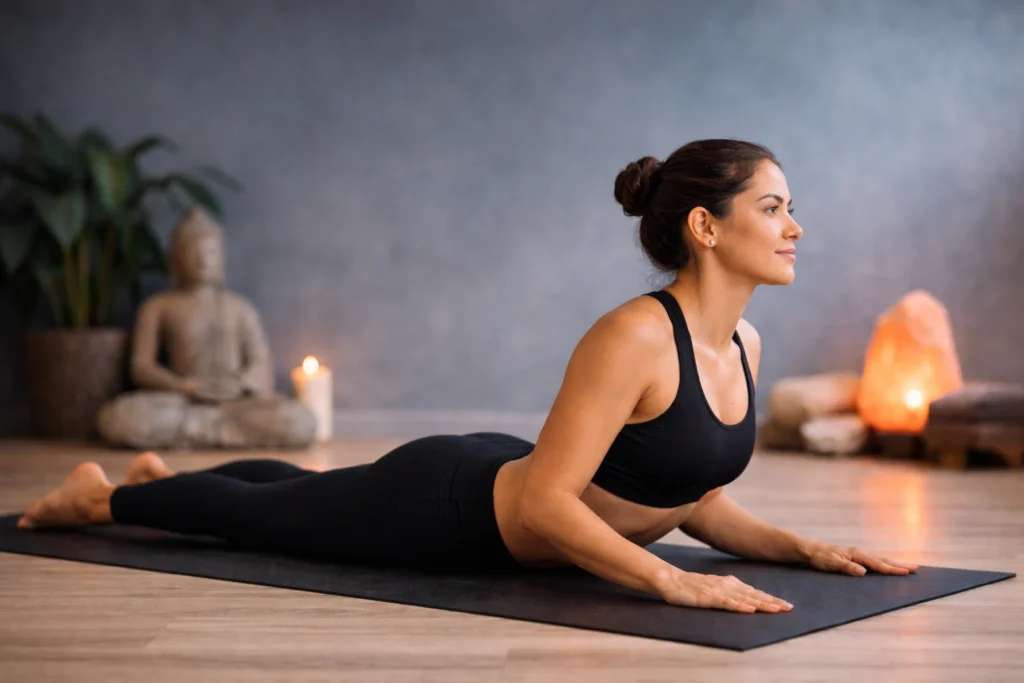
Table of Contents
- What are Prone Yoga Poses?
- Why are prone yoga poses important?
- Important Prone Yoga Exercises
- An Anatomical Approach to Prone Yoga Poses
- Why is alignment important?
- Precautions
- Contraindications (Do not do if:)
- Common Mistakes
- Mental and Emotional Effects
- Rishikesh Yog Kendra – Yoga School in Rishikesh
- In conclusion
- FAQs (Frequently Asked Questions)
In the world of yoga, there are some postures that appear simple, yet have profound effects. Prone poses, i.e., yoga postures performed on the stomach, fall into that category.
I have personally experienced that whenever the back feels heavy, the shoulders feel hunched, or the energy is low, a few minutes of prone practice rebalances the body. This practice gradually builds strength. It awakens the back of the body. It deepens the breath.
Often, we pursue difficult and flashy postures in yoga, but the true foundation is often built on the ground. Prone yoga poses provide that foundation.
What are Prone Yoga Poses?
“Prone” means lying on the stomach. Therefore, prone poses are yoga postures performed on the stomach. In these postures, the body remains facing the ground, and the face is facing down.
Most prone yoga poses involve raising the chest, head, or legs, causing the spine to bend backward. For this reason, they are classified as backbend postures.
These days, some people also search for terms like “prone bone pose” or “prone bone yoga pose.” This is not a term from traditional yoga. It generally refers to postures performed on the stomach that strengthen the muscles of the back, waist, and spine.
In short, prone yoga poses are postures that activate the back of the body, open the chest, and strengthen the spine.
Why are prone yoga poses important?
In today’s lifestyle, we spend most of our time bent forward—while looking at mobile phones, working on laptops, or driving. Gradually, the shoulders begin to fall forward, the neck protrudes, and pressure on the waist increases. This is where prone yoga poses create balance.
These postures encourage the body to work in the opposite direction. They open, and straighten. They strengthen.
1. Strengthens the Spine
Prone yoga poses involve spinal extension, meaning the spine actively bends backward. This activates the deep back muscles. With regular practice, both the lower back and upper back strengthen. Weakness caused by prolonged sitting gradually decreases.
2. Improves Posture
A slumped back and rounded shoulders have become common problems today. Prone postures pull the shoulders back and lift the chest, reminding the body of correct posture. Improvements in standing and sitting posture will be visible within a few weeks.
3. Opens the Chest and Increases Breathing
When the chest is closed, the breathing is shallow. The prone backbends open the chest, increasing the lung capacity. Breathing naturally deepens. Deep breathing also calms and stabilizes the mind.
4. Activates the Core and Back Muscles
Although these are backbends, proper practice lightly activates the abdominal muscles. The glutes and hamstrings are also engaged, which improves the balance of the body.
5. Mental Effects
Backbend postures are often considered energy-boosting. They reduce lethargy and bring the body into an open posture, which also increases self-confidence. One feels light and alert after practice.
Important Prone Yoga Exercises
1. Bhujangasana (Cobra Pose)
This is one of the most suitable prone poses for beginners.
Practice Method:
- Lie on your stomach.
- Place your palms under your shoulders.
- Keep your legs straight and together behind you.
- Inhale and slowly raise your chest.
- Keep your shoulders back and down and your neck long.
Note:
Don’t rush to rise. Instead of straining your back, lengthen your chest forward.
Benefits:
- Strengthens the spine
- Relieves shoulder stiffness
- Relieves mild back pain
2. Shalabhasana (Locust Pose)
This asana helps build strong back muscles.
Practice:
- Lie on your stomach.
- Your hands are kept close to your body.
- Inhale and lift your chest and legs.
- Keep your neck straight.
Benefits:
- The lower back becomes stable.
- Glutes activate.
- Hamstrings strengthen.
3. Dhanurasana (Bow Pose)
This is a slightly advanced prone yoga pose.
Practice:
- Bend your knees.
- Hold your ankles with your hands.
- Inhale and push your legs back and upward.
- Lift your chest and thighs off the ground.
Benefits:
- Spinal flexibility is increased.
- Digestion is improved.
- Energy levels are boosted.
4. Makarasana (Crocodile Pose)
This is a very important pose for relaxation.
Practice:
- Lie on your stomach.
- Put your hands on top of each other.
- Place your head on your hands.
- Breathe deeply and slowly.
This pose balances the body and nervous system after deep backbends, keeping the practice safe and stable.
An Anatomical Approach to Prone Yoga Poses
If we simply consider prone yoga poses to be “backbending” postures, understanding them is incomplete. In fact, these postures activate the entire posterior chain of the
body. Executed with proper understanding and proper alignment, they develop deep strength without harming the spine.
Active Muscles:
1. Erector Spinae
This muscle group stretches lengthwise along both sides of the spine. When you do prone exercises like Bhujangasana or Shalabhasana, these muscles are engaged to lift and support the spine.
If these muscles are weak, the lower back is put under additional strain.
2. Gluteus Maximus
This is one of the largest muscles in the body. In prone poses, the glutes are mildly active and provide support to the lumbar spine.
Remember—they should not be overly tightened. Just moderate exercise is required.
3. Hamstrings
The muscles at the back of the thighs help to balance the legs.
They play an important role in Shalabhasana or Dhanurasana.
Strong hamstrings help reduce back pressure.
4. Shoulder Stabilizing Muscles
Muscles like the rhomboids, trapezius, and rotator cuff help keep the shoulders back and down.
If the shoulders roll up toward the ears, it can increase strain on the neck. Therefore, active but comfortable alignment of the shoulders is essential.
Why is alignment important?
If alignment is not correct:
- There may be more pressure on the lower back.
- Uneven curvature of the spine
- There may be stiffness in the neck.
Therefore, the goal in prone yoga poses shouldn’t be simply “getting up.” The goal should be to get up while maintaining length.
Rise slowly. Move with your breath. Don’t jerk.
Prone exercises performed with proper technique strengthen the spine. Improper execution may cause increased pressure on the back.
This is why awareness and proper execution are important for prone yoga poses.
Progression from Beginner to Advanced
The progression to prone yoga poses has to be done carefully.Progressing according to body readiness is the key to safe practice.
Beginner Level
- Makarasana—for relaxation and breath awareness.
- Salamba Bhujangasana – A gentle backbend of the spine.
- Bhujangasana (lighter version)—for opening the chest and activating the back. Intermediate Level
- Shalabhasana—for increasing lower back and glute strength.
- Bhujangasana (full version)—for greater height and stability.
- advanced Level
- Dhanurasana—to do a deeper backbend while using the entire back.
Variations of advanced backbends, dynamic, or those that require holding a pose.
Gradually work up to the exercise. Do not rush. The key to practicing safely is to practice regularly, pay attention to alignment, and breathe mindfully.
Precautions
This is an important part of the chapter because prone yoga poses target the muscles in the lower back and abdominal area. In the following situations, take special care:
- Abdominal surgery: Lying on your stomach and doing backbends may cause pressure on the sutures or tissues in the abdominal area.
- Hernia: Since lying on your stomach can increase the pressure on the abdominal region, it is best to avoid this position to avoid further aggravation of the hernia.
- Pregnancy: Stomach positions should be avoided altogether during pregnancy.
- Severe back pain: Before attempting deep backbends, it is best to consult a specialist.
- Hypertension: Deep or prolonged backbends can be risky.
Contraindications (Do not do if:)
Avoid prone yoga poses or practice them with utmost caution under expert supervision if you have any of the following conditions:
- Slipped disc—Backbends can further press upon the disc.
- Serious spine injury—Incorrect movements can further aggravate the injury.
- Swelling or severe abdominal pain—lying on your stomach can increase discomfort.
- Recent surgery—especially after surgery related to the abdomen, spine, or hip.
If you feel sharp, stabbing, or unusual pain during the practice, stop immediately. Mild strain is normal, but severe pain is a warning sign.
Common Mistakes
These mistakes are often seen when performing prone yoga poses:
- Excessive pressure on the hands—Especially in Bhujangasana, people exert all their strength through their hands, which puts unnecessary strain on the waist.
- Holding the breath—When you do backbends, your breathing should be smooth and deep. Holding the breath increases tension in the body.
- Excessive waist bending—focusing only on the lower back muscles instead of stretching the entire spine can lead to injuries.
- Jerking movements—Sudden movements to rise or lower can shock the muscles.
Remember that awareness and control are more important in yoga than speed.Only slow, steady, and mindful practice can give safe and deep results.
20-Minute Balanced Prone Sequence
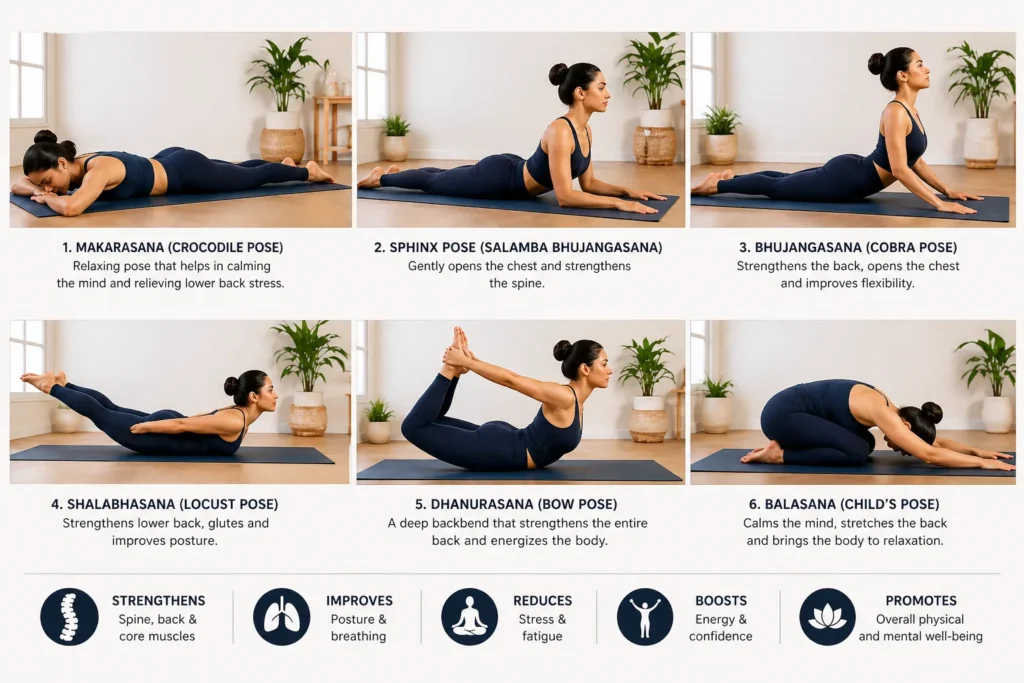
This short but effective sequence strengthens the spine, opens the chest, and ultimately provides balanced relaxation.
Makarasana – 2 minutes
Stabilize the body with deep breaths. Allow the abdomen and lower back to relax.
Salamba Bhujangasana – 5 breaths
Keep the elbows under the shoulders. Lift the chest slightly and keep the neck long.
Bhujangasana – 7 breaths
Lift the chest while inhaling. Do not strain the waist; lengthen the spine.
Shalabhasana – 3 rounds
Hold for 3–5 breaths per round. Rise slowly and lower slowly.
Dhanurasana – 5 breaths
Lift the chest while pushing the legs back. Breathe smoothly.
Balasana – 2 minutes
Bring the spine to neutral. Breathe deeply and completely relax the body.
This pose provides strength, flexibility, and balance to the body. Regular practice will strengthen the back and calm the mind.
Mental and Emotional Effects
Prone backbends are often called “heart openers” because they open the chest area and break the body from a habitual forward bend. In today’s lifestyle, we spend most of
our time bent forward—due to mobile phones, laptops, or driving. When the chest opens, breathing automatically deepens.
When breathing is deep and rhythmic, the nervous system calms down. This lowers stress and stabilizes the mind.
practice:
- Makes you more sure of yourself
- Reduces mental fatigue
- Makes you more open to feelings and boosts your energy
Slow, careful, and even practice of these poses is good for both the body and the mind and emotions.
Rishikesh Yog Kendra – Yoga School in Rishikesh
Rishikesh Yog Kendra is a well-known yoga school in Rishikesh, providing carefully crafted Yoga Teacher Training courses for students at all levels. The courses combine the traditional yogic system with contemporary teaching methods, ensuring a well-rounded and comprehensive study of asana, pranayama, meditation, anatomy, and teaching methods. The courses offered include a 100-Hour YTT (11 days), 200-Hour YTT (22 days), and 300-Hour YTT (28 days) and Pre and Postnatal Yoga Teacher Training . Whether you are a beginner learning from scratch or an existing practitioner seeking to enhance your knowledge, the carefully planned course helps you to develop step by step and confidently.
The school offers a serene study environment, along with a comfortable stay and three healthy meals a day to sustain the students during the training period. To add to the experience, the students also get to enjoy selected outings to help them discover the spiritual and natural side of Rishikesh.
In conclusion
Even though they look easy, prone yoga poses have a lot of benefits. These poses help open up the body to its straight form, strengthen the muscles in the spine, and correct slouching. Regular practice deepens breathing, stabilizes the back, and improves energy levels.
In my experience, whenever the practice feels heavy or unbalanced, a few minutes of mindful prone practice instantly resets the body. It gradually builds strength and provides secure support to the lower back.
You should include prone yoga poses in your routine if you want to have a well-rounded yoga practice.
You will see the results automatically.
FAQs (Frequently Asked Questions)
Q. What is the prone pose?
Ans. A yoga posture performed on the stomach.
Q. Can prone yoga poses be done daily?
Ans. Yes, but practice in moderation.
Q. Does it help with back pain?
Ans. Gentle practice strengthens muscles.
Q. What is the Prone Bone Pose?
Ans. This is not a traditional yoga term.
Q. How long should one hold the pose?
Ans. 3–8 breaths are sufficient.
Q. Can beginners do Dhanurasana?
Ans. Build strength in Bhujangasana and Shalabhasana first.