Español


Tadasana (Mountain Pose): Benefits, Steps and Guide
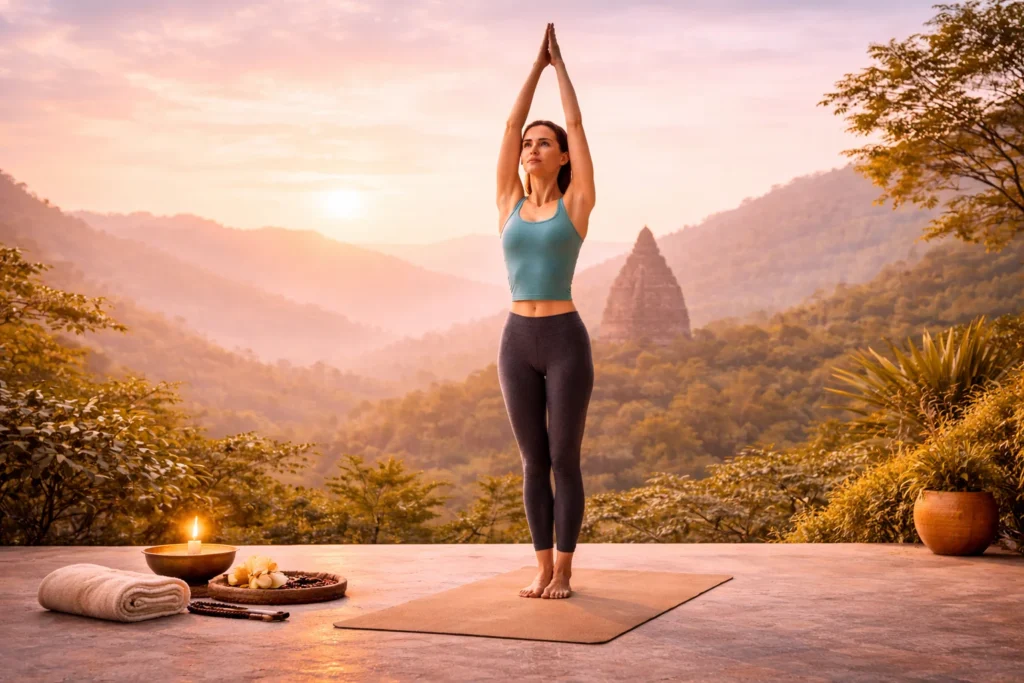
Table of Contents
- Introduction: Tadasana (Mountain Pose)
- What is Tadasana (Mountain Pose)?
- The Significance of Tadasana (Mountain Pose) in Yoga
- How to Perform Tadasana (Mountain Pose)
- What Are the Benefits of Tadasana (Mountain Pose)?
- Does Tadasana (Mountain Pose) Increase Height?
- Tips for Beginners
- Common Errors in Tadasana (Mountain Pose)
- Personal Experience
- About Rishikesh Yog Kendra
- Conclusion
- FAQs
Introduction: Tadasana (Mountain Pose)
In the world of yoga, there are certain asanas that appear very simple at first glance, yet possess a profound impact. Tadasana—known in English as the Mountain Pose—is one such asana. At first sight, it may seem like nothing more than simply standing still; however, in reality, it serves as the foundation for overall body balance and correct posture.
Nowadays, many people struggle with issues such as back pain, neck tension, and poor posture due to incorrect sitting and standing habits. In such cases, the Tadasana pose may prove itself to be an important and effective pose.
What we will learn in this article:
- What does Tadasana mean?
- How to perform the Tadasana pose?
- What are the benefits of Tadasana?
- Does Tadasana increase height?
What is Tadasana (Mountain Pose)?
In Sanskrit, “Tada” means “mountain,” and “Asana” means “posture” or “position.” Thus, Tadasana, or the mountain pose, represents an individual standing tall, upright, and balanced, much like a mountain.
Although this pose may seem extremely simple at first glance, its importance in the context of the practice of yoga is profound. This pose is not simply a pose in which an individual is required to stand upright; rather, it is an essential tool through which an individual can comprehend and refine the correct alignment of the entire body. When you stand in the Tadasana pose, you are required to focus on the alignment of your feet, spine, shoulders, and head.
Moreover, this pose is essential in helping an individual develop a better association with his or her mind. As you stand steady and focus on your breath, the mind gradually begins to settle and calm down. For this reason, Tadasana (the Mountain Pose) is often utilized as a preparatory step for meditation. With consistent practice, one comes to realize that this seemingly simple pose is, in fact, a vital method for cultivating body awareness, balance, and stability.
The Significance of Tadasana (Mountain Pose) in Yoga
Although this asana appears quite simple, it serves as the foundational starting point for almost every yoga practice. It assists in aligning the body in a proper posture in a smooth and effortless manner.
Moreover, Tadasana, or the Mountain Pose, assists in aligning the body in a proper manner, which makes it easier to perform more complex asanas later on. When you practice this asana in a mindful manner, you start feeling extremely aware of each and every part of your body.
For this very reason, this asana cultivates balance, stability, and body awareness. Additionally, regular practice improves your posture and renders your overall yoga practice both more effective and safer.
How to Perform Tadasana (Mountain Pose)
Step 1 – Stand Upright
The first step is to stand upright with your feet placed either together or slightly apart. At this time, you should also ensure that the entire position of your body is comfortable and that you have focused entirely on balancing.
Step 2 – Establish Body Balance
Next, you should distribute your entire weight equally across both feet. This is an important step in balancing. You should also try to maintain a feeling of balance by grounding your feet firmly.
Step 3 – Keep the Spine Straight
After this, you should keep your spine as straight as possible and also try to relax your shoulder muscles. At the same time, you should also try to lift up your chin in order to maintain the alignment of your neck and spine.
Step 4 – Raise Your Arms
Next, you should slowly raise both your arms upwards and also interlock your fingers. You should then turn your hands towards the ceiling and also try to straighten your arms.
Step 5 – Stretch the Body Upward
After this, you should also try to stretch your entire body upwards. You may also choose to stretch your heels upwards if you want to.
Step 6 – Focus on Your Breath
You need to breathe in slowly while maintaining your balance. The goal is to breathe normally and deeply in such a way that you feel calm and composed both physically and mentally.
Step 7 – Return to the Normal Position
You need to come back to the normal position and relax your body. You need to lower your heels and come back to your normal position in order to let your body get back its equilibrium.
What Are the Benefits of Tadasana (Mountain Pose)?
1. Improves Posture
First and foremost, one of the key benefits of Tadasana is that it improves the body’s posture. It helps reduce the habit of slouching and fosters the habit of keeping the spine erect, making the body appear more balanced and graceful in the long run.
2. Enhances Balance
This asana helps improve the body’s sense of balance. When you place your weight equally on both feet, stability in the human body is achieved, and gradually, control over stability also improves.
3. Strengthens the Legs
This pose helps strengthen the thighs, knees, and ankles if practiced regularly. Moreover, it also keeps the muscles of the legs active, thus offering a sense of strength while walking, standing, etc.
4. Increases Body Awareness
You gradually begin to develop a better understanding of your body’s positioning. Moreover, this yoga pose encourages better coordination between the body and mind, which then improves awareness of even the smallest movements.
5. Improves Breathing
Standing upright helps open the chest, thus making it easy to breathe. At the same time, it encourages the practice of deep and controlled breathing, which is very effective in improving mental calmness and increasing energy levels.
6. Reduces Fatigue
It makes the body feel lighter. This pose is especially helpful after you’ve been sitting or standing for a while. It can really help your body unwind and recharge.
Does Tadasana (Mountain Pose) Increase Height?
This is a very common question.
Tadasana does not directly increase height—especially once the body’s natural growth phase has concluded. However, this does not mean that it has no effect whatsoever.
In fact, the Tadasana pose helps to improve your posture. When one is upright and in the correct position, one tends to look taller. In most cases, people may look shorter than their actual heights because of their postures and habits, such as sitting and walking. This is an area where Tadasana is able to correct one’s position. In addition, the pose is able to help children and young adults in their growth since their bodies are still in the development stage. However, a balanced diet, adequate rest, and exercise are also important.
Tips for Beginners
If you are attempting the Tadasana pose for the first time, keeping a few small yet significant points in mind can make your practice much more effective.
- Do not rush.
- Practice in front of a mirror.
- Focus on your breath.
- Practice a little bit every day.
In addition to this, it is also important to be particularly cautious about the position of your feet and the balance of your body in the initial stages. The aim should be to evenly distribute your body weight on both your feet so that your body is in a relaxed and controlled state. In addition to this, it is also important to maintain a steady and deep rate of natural breathing during the practice of the asana, as this will help in maintaining a calm state of mind and body. In my opinion, the asana seemed to be relatively simple in the initial stages. Over time, I realized that Tadasana is more than just a standing pose. It’s a straightforward but powerful way to improve how we feel and move our bodies.
Common Errors in Tadasana (Mountain Pose)
Putting Weight on One Leg
A frequent mistake is unintentionally leaning on one leg, which can throw off your balance. Therefore, it is essential to distribute your weight evenly across both feet.
Tensing the Shoulders
Holding your shoulders too tightly can increase physical tension throughout the body. Therefore, keep your shoulders relaxed and comfortable.
Holding Your Breath
Many people tend to hold their breath while trying to concentrate. However, it is far more important to maintain a normal, deep breathing pattern.
Rushing Through the Practice
Performing asanas too hastily prevents you from reaping their full benefits. Therefore, it is better to practice slowly and mindfully.
Personal Experience
When I first started practicing Tadasana, it struck me as very simple. To be honest, in the beginning, I felt there was nothing particularly special about it—after all, it seemed to involve nothing more than just standing upright. However, as I started to practice it with proper attention and technique, my point of view changed completely.
I soon realized, after a few days of practice, that I had never even stood properly in the first place, as I had the tendency to slouch slightly with my shoulders, as well as unevenly place weight on one of my legs. Nevertheless, the Tadasana pose helped me correct these minor misalignments in my posture.
Furthermore, as I began to focus on my breath, the pose started to feel even more calming and grounding. Gradually, it ceased to be merely a yoga posture; instead, it evolved into a practice that offers me an opportunity to connect with my body and mind every single day.
In my opinion, the greatest advantage of Tadasana is that it teaches us that even things that may be simple at first glance may have a profound impact at another level.
About Rishikesh Yog Kendra
If you are looking for a place to learn yoga in a serene, authentic, and dedicated atmosphere, Rishikesh Yog Kendra in Rishikesh is the right place for you. The school provides certified 100-hour yoga teacher training in Rishikesh, 200-hour YTTC in Rishikesh, and a 300-hour yoga teacher training course, along with specialized programs such as Aerial Yoga TTC and the yin yoga teacher training course in rishikesh. These courses have been designed thoughtfully for both beginners and those seeking to advance their practice.
Students learn the practice of yoga asanas, pranayama, meditation, yoga philosophy, and teaching methodology. This helps them develop a strong and confident foundation. Besides this, the peaceful location of Rishikesh, together with a focus on a healthy yogic lifestyle, makes it a highly enriching experience.
Upon completing the program, graduates receive certification from Yoga Alliance. This qualification gives them access to teaching yoga all over the world, enabling them to progress further on their journey with confidence.
Conclusion
Tadasana is a simple yet effective yoga posture that may be easy to learn but requires deep concentration while practicing. This posture is extremely important in providing stability, balance, and proper alignment to the body. Regular practice of this posture not only improves posture but also improves the overall alignment of the entire body.
In addition to this, Tadasana is extremely important in providing a proper foundation for the practice of yoga. This enables the proper execution of complex and complicated poses in the most natural manner possible. This is because through gradual practice, an individual becomes extremely aware of the proper balance of their own body.
It is also important to note that patience is required while practicing this posture. Thus, with the proper technique and practice, Tadasana, or the Mountain Pose, is no longer simply a simple posture but becomes an effective means for providing harmony to the entire body and mind.
FAQs
Q: What does Tadasana mean?
Ans. It is a pose of standing steady like a mountain.
Q: How to perform Tadasana correctly?
Ans. Stand up straight and stretch your body upward and maintain your balance.
Q: Does Tadasana increase height?
Ans. No, it does not increase height but improves posture.