Español


Garudasana (Eagle Pose): Steps, Benefits, Tips & Precautions for Beginners
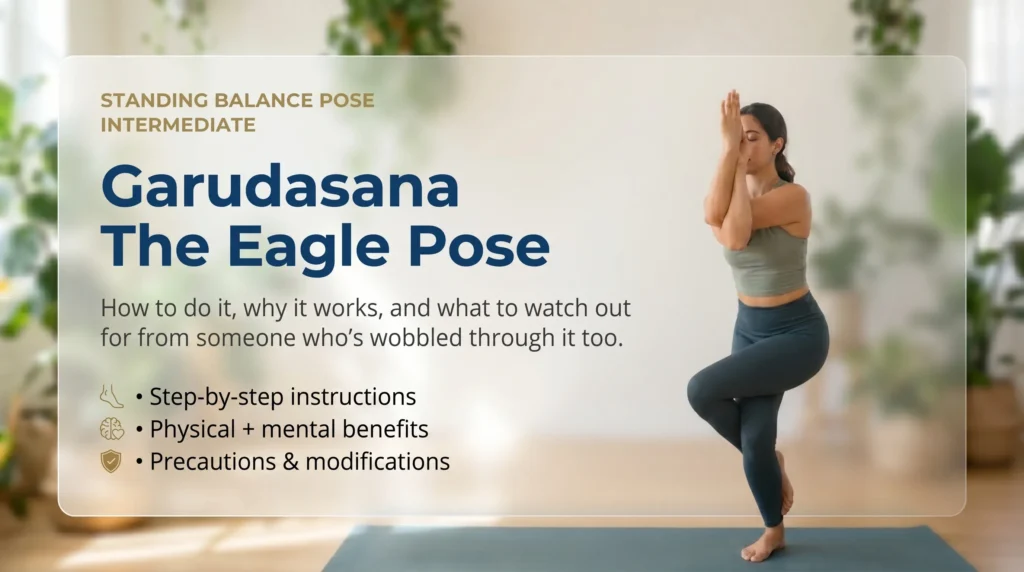
Table of Contents
- What Is Garudasana?
- Step-by-Step Instructions
- 1 Begin in Tadasana (Mountain Pose)
- 2 Soften your knees and shift your weight
- 3 Cross the right leg over the left
- 4 Wrap the arms
- 5 Find your drishti — your gaze point
- 6 Hold and breathe — 5 to 10 breaths
- 7 Release and repeat on the other side
- The Benefits: What This Pose Gives You
- Physical Benefits of Garudasana
- Shoulders and upper back
- Hips and outer thighs
- Ankles and calves
- Core strength
- Mental Benefits of Garudasana
- Precautions & Who Should Be Careful
- Rishikesh Yog Kendra, Yoga School in Rishikesh
- Closing Thought
- FAQs About Garudasana (Eagle Pose)
- Is Garudasana good for beginners?
- What are the main benefits of Eagle Pose?
- Why is Eagle Pose difficult?
There’s a moment in Eagle Pose where everything gets quiet. Your weight settles into one foot, your arms twist together in front of you, and suddenly — all the noise in your head has nowhere to go. That’s what Garudasana is really about. Not just stretching tight shoulders or loosening stiff hips (though it absolutely does both). It’s about learning to be fully present in a body that, for once, has nowhere to hide.
What Is Garudasana?
In Sanskrit, garuda means eagle — the mythical king of birds and vehicle of the god Vishnu. The pose asks you to embody that eagle: perched, powerful, intensely focused on a single point. In practice, it means balancing on one leg while the other wraps around it, and the arms mirror that same crossing and coiling in front of your chest.
It looks complicated. And honestly, the first few times, it feels complicated too. But once your body starts to understand the pattern — the squeeze, the lift, the gaze — it becomes one of those poses you genuinely crave
Step-by-Step Instructions
Take your time with each step. There’s no rush here. Read through once, then come back to your mat.
1 Begin in Tadasana (Mountain Pose)
Stand tall at the top of your mat with your feet hip-width apart. Take a breath in, and as you exhale, let your shoulders drop away from your ears. Find your feet on the floor — feel all four corners of each foot pressing down. This grounding at the start makes everything else steadier.
2 Soften your knees and shift your weight
Gently bend both knees, coming into a slight squat — think of it like sitting back about 20%. Shift your weight slowly onto your left foot. Keep your left knee soft, not locked.
Tip: Pressing through the heel of your standing foot gives you the most stability. If you feel yourself pitching forward onto your toes, consciously push that heel down.
3 Cross the right leg over the left
Lift your right foot off the floor and cross your right thigh over your left thigh — high up, just above the knee. If you can, hook your right foot around the back of your left calf. If that doesn’t happen today, just cross your legs and rest your toes lightly on the floor beside your left foot.
Tip: Don’t worry if you can’t double-wrap your legs. A lot of people never do, and the pose is just as real without it. What matters is the squeeze of the thighs together.
4 Wrap the arms
Stretch your arms forward at shoulder height. Cross your left arm over your right, bending both elbows so your forearms are upright. Now gently bring your palms to face each other — or touch them together if you can. Lift your elbows slightly to feel that opening stretch between your shoulder blades.
Tip: The arm wrap is where most of us feel tight. If your palms don’t meet, that’s perfectly fine — just press your forearms or wrists together. Over time, the space between your shoulder blades will open up.
5 Find your drishti — your gaze point
Pick a single, still point in front of you — a spot on the wall, a mark on the floor ahead. Fix your eyes there and let your gaze soften. This is your anchor. When your drishti is steady, your balance tends to follow.
Tip: Blinking fast and darting your eyes around is a sign of a nervous system in overdrive. Take one slow breath and let your eyes go soft. The wobbling usually settles.
6 Hold and breathe — 5 to 10 breaths
Stay here. Keep a gentle squeeze through your thighs and a soft lift through your elbows. Breathe slow and steady. You might wobble — that’s not failure, that’s balance work happening in real time. If you fall out, just step back in.
7 Release and repeat on the other side
Slowly unwind your arms, then your legs. Stand in Mountain Pose for a breath or two. Notice if you feel any difference between the two sides of your body — you almost certainly will. Then do the whole thing again, this time standing on your right foot with your left leg crossing over.
The Benefits: What This Pose Gives You
Eagle Pose works quietly. You don’t realize how much it’s doing until you’re in it — or until you step out and your shoulders feel three inches lower than they did five minutes ago.
Physical Benefits of Garudasana
Shoulders and upper back
The arm wrap is a deep stretch for the rhomboids and the muscles between the shoulder blades — exactly where desk tension loves to live. It’s one of the few yoga poses that reach that specific spot.
Hips and outer thighs
Crossing the legs creates a sustained stretch through the IT band and the hip rotators. If you spend a lot of time sitting, this is your pose.
Ankles and calves
The standing leg gets a real workout — the ankle stabilizers fire constantly just to keep you upright. Over time, this builds genuine ankle strength and proprioception.
Core strength
Balancing on one leg quietly activates the deep stabilizers of your core, especially around the hip and lower back. You’re not “working your core” in an obvious way, but it’s happening.
Mental Benefits of Garudasana
Eagle Pose demands your attention in a way that most standing poses don’t. Because you have to hold a complex shape and balance simultaneously, there’s no room left over for to-do lists or replaying that awkward conversation from last Tuesday. The pose fills your whole field of awareness.
Over time, this kind of single-pointed focus — what the yogic tradition calls dharana — starts to show up in other areas of life. The ability to stay present under pressure, to hold steady when things feel uncertain. It sounds like a lot to attribute to one balancing pose. But those of us who practice it regularly know that something quiet and real happens here.
Precautions & Who Should Be Careful
Eagle Pose is accessible to most people, but it does put specific demands on certain joints. Here’s what to keep in mind:
Knee issues: The crossed-leg position puts rotational stress on the knee joint. If you have a current knee injury, a recent surgery, or chronic knee pain, skip the leg wrap entirely. Instead, simply cross one ankle over the opposite knee (like a figure-four shape) and sink into a single-leg squat. Same hip stretch, no knee torque.
Shoulder or elbow injuries: The arm crossing can compress the shoulder joint, depending on the nature of an existing injury. If you have a rotator cuff issue, a shoulder impingement, or post-surgical limitations, modify by simply hugging your arms across your chest in a self-embrace instead of wrapping. You’ll still get the grounding benefit of the pose.
Balance challenges and inner ear conditions: Practice near a wall until you feel steadier. There’s no shame in fingertip contact with a wall — plenty of advanced practitioners do this. It simply removes the fear of falling, which lets your body relax into the pose rather than grip through it.
Pregnancy (second and third trimester): As the belly grows, balance shifts significantly. The crossed-leg position can feel unstable or uncomfortable. Use a chair for support, or skip this pose in favour of gentler hip openers like Baddha Konasana. Always consult your healthcare provider.
Hypermobility: If your joints are naturally very flexible, be careful not to sink too deeply into the squatting part of the pose or twist your knee too far. Instead of focusing on depth, think about hugging the muscles to the bones.
A Few Real-Life Tips from the Mat
Sometimes the small things make the biggest difference:
- Don’t rush into the wrap. Take your time setting up your base first.
- If you keep falling out, smile. It means you’re trying. Balance improves with practice.
- Keep your breath steady. If your breathing becomes tight, ease up a little.
- Your hips might feel tight one day and open the next. That’s normal.
- Focus your eyes before you wrap your legs—it helps prevent wobbling early on.
And one important thing:
Your version of the pose is enough. Whether your foot hooks or not, whether your palms touch or stay apart—it’s all part of the practice.
Rishikesh Yog Kendra, Yoga School in Rishikesh
At Rishikesh Yog Kendra, we work closely with students to help them understand not just how a pose looks, but how it should feel from the inside. If you’re ready to take your practice further, you can explore our 200 Hour Yoga Teacher Training in Rishikesh, where we break down alignment, breath, and traditional practice step by step. Or, if you simply want a peaceful reset, our Yoga Retreat in Rishikesh near the Ganga gives you space to slow down, practice daily, and reconnect with yourself.
It’s a different experience practicing in Rishikesh—the energy, the stillness, the way your practice naturally deepens without force. If that calls to you, you’re always welcome to join us.
Closing Thought
The real gift of Garudasana isn’t flexibility or strength — it’s the reminder that you can be completely tangled up, standing on one leg, and still find your balance. Step onto your mat, find your gaze point, and give it a try. Wobbling included.
So the next time you step into Eagle Pose, don’t rush.
Wrap slowly.
Breathe deeply.
And let the pose meet you where you are.
FAQs About Garudasana (Eagle Pose)
Is Garudasana good for beginners?
Yes, beginners can practice with simple modifications like keeping toes on the floor.
What are the main benefits of Eagle Pose?
It improves balance, stretches shoulders, and opens hips.
Why is Eagle Pose difficult?
It combines balance, coordination, and flexibility in one posture.