Español


Shavasana (Corpse Pose): Benefits, Procedure, & Beginner Guide
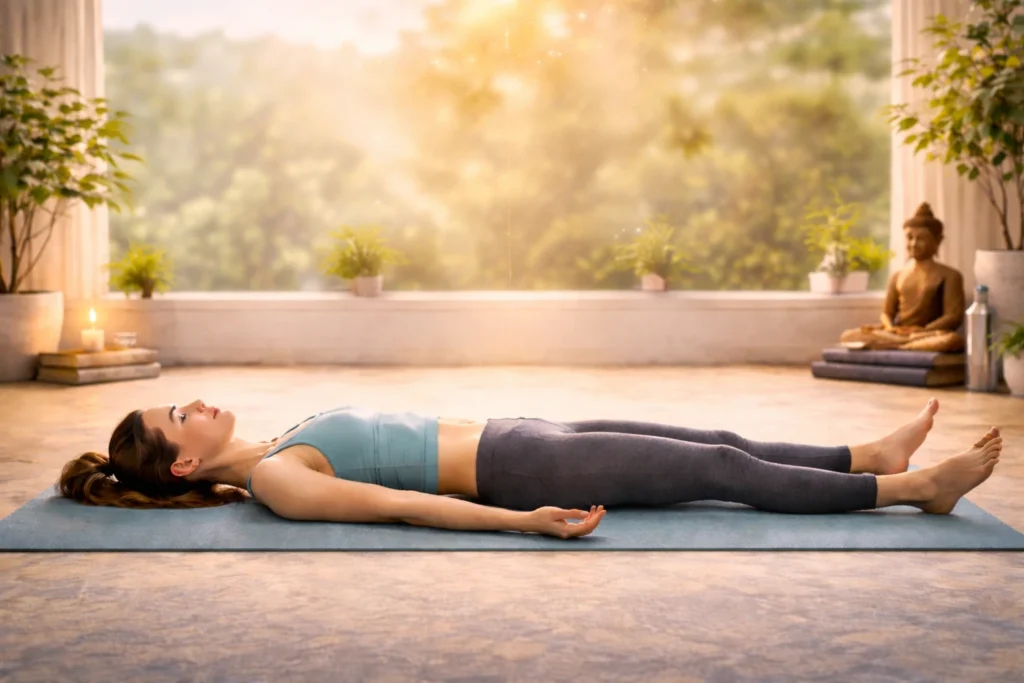
Table of Contents
- Introduction: Shavasana (Corpse Pose)
- What is Shavasana (Corpse Pose)?
- The Meaning of Shavasana (Corpse Pose)
- The Role of Shavasana (Corpse Pose) in Yoga Practice
- Why is Shavasana (Corpse Pose) important?
- Shavasana Procedure (Corpse Pose) | How to Perform Shavasana
- Benefits of Shavasana Pose (Corpse Pose)
- Common Mistakes When Practicing Shavasana (Corpse Pose)
- A Beginner’s Tip
- The Ideal Time to Perform Corpse Pose, or Shavasana
- Rishikesh Yog Kendra—Yoga School in Rishikesh
- Conclusion
- FAQs
Introduction: Shavasana (Corpse Pose)
There are many yoga poses that can activate the body, and there are some that can relax the body as well. Shavasana (corpse Pose) is one such important pose. It is not just the activation of the body that is achieved through yoga. In fact, yoga is the process through which balance is achieved between the body and the mind.
Shavasana is generally practiced at the end of the yoga session. This is because the body’s muscles are active after other postures and need rest. In this situation, Shavasana helps the body gradually return to a calm state.
At first glance, Shavasana seems very simple because the person simply lies on their back. However, this posture is actually a practice of conscious relaxation. If done in the right way, it not only relaxes the body, but it also gives mental peace. Besides, through constant practice, it is possible to control stress and attain mental clarity.
What is Shavasana (Corpse Pose)?
The Meaning of Shavasana (Corpse Pose)
In Sanskrit, “Shava” means “dead body,” and “asana” means “sitting or standing position.” Therefore, Shavasana literally means remaining in a state of complete stillness and calm, like a dead body. In this posture, a person lies on their back and completely relaxes every muscle in their body.
However, it doesn’t simply mean lying down. In reality, Shavasana is a process of conscious relaxation. In this posture, the body remains still, but the mind remains aware. The individual becomes aware of the breath, body sensations, and state of mind.
This is the reason why Shavasana is regarded as the most important relaxation pose in the practice of yoga. Through the practice of this pose, the individual is able to alleviate the tensions accumulated in the body and bring the mind into a state of relaxation. In addition, many yoga experts are of the view that during the practice of Shavasana, the body and the mind reach a state of relaxation. During this time, the body gradually rebalances its energy, and fatigue begins to subside.
The Role of Shavasana (Corpse Pose) in Yoga Practice
Yoga teachers often have Shavasana performed at the end of any yoga session. There is a very important reason behind this. When we perform various yoga asanas, the body’s muscles are activated, the heart rate may increase slightly, and the flow of energy in the body increases. Therefore, the body needs to rest at the end of the practice. In such a situation, Shavasana gives the body an opportunity to gradually return to a normal and balanced state.
Besides, Shavasana also helps stabilize the effects of yoga practice. When we lie down quietly and concentrate on our breathing, the activities going on within the body gradually begin to balance.
Many yoga instructors believe that if Shavasana is not performed at the end of a yoga session, the benefits of the practice cannot be fully realized. Therefore, this asana is not only used for relaxation but also considered an important part of completing a yoga practice.
Why is Shavasana (Corpse Pose) important?
Mental stress has become a common problem in today’s lifestyle. Constant work, digital screens, and mental pressure can often leave the body feeling tired and the mind restless. In such a situation, the body needs not only physical rest but also mental relaxation. This is why practicing Shavasana is considered important. This asana helps gradually bring both the body and mind into a state of calm. When a person lies still for a while and focuses on their breathing, the body’s muscles begin to relax, and mental stress also begins to decrease.
First, it provides deep relaxation to the body. Furthermore, it slows and balances breathing, allowing the mind to naturally calm down. Regular practice can relieve the fatigue of the day.
Likewise, Shavasana gives us the opportunity to become aware of the sensations in our bodies. When we remain calm for a few minutes, we can feel how the body gradually comes into a state of relaxation. This is why in yoga practice, Shavasana is considered not only a posture of relaxation but also a practice of balance and awareness.
Shavasana Procedure (Corpse Pose) | How to Perform Shavasana
The Shavasana procedure is simple, but it requires attention, patience, and awareness. When practiced correctly, it can bring deep relaxation to both the body and mind.
Step 1 – Choose a Comfortable Location
First, choose a quiet, clean, and airy space where you will be free from distractions. To practice without strain, lie on your back on a yoga mat and arrange your body in a comfortable position.
Step 2: Position Your Body
To allow your body to remain fully relaxed, spread your legs slightly apart. Keep your palms facing up and your hands slightly apart. The body automatically relaxes in this position.
Step 3: Rest Your Eyes
Now, slowly close your eyes, and your body should be in a state of complete relaxation.
Step 4: Pay attention to your breathing
Take a deep breath, followed by a slow exhale.
Step 5 – Calm Down
You are required to stay calm in this position for 5-10 minutes, during which you are required to observe small changes in your body while your mind slowly enters a state of complete relaxation.
Benefits of Shavasana Pose (Corpse Pose)
Shavasana pose, also known as Corpse Pose, has the potential to bring great benefits to both the mind and the body.
Practicing Shavasana regularly may:
- Reduces Mental Stress
- Provides Deep Relaxation to the Body
- Helps Improve Concentration
- Improves Sleep Quality
- Enhances Energy Levels
Reduces Mental Stress
First of all, Shavasana helps calm the mind. When we lie down quietly for a few minutes and breathe slowly, mental stress gradually begins to subside. Regular practice can also reduce anxiety and restlessness.
Provides Deep Relaxation to the Body
The body’s muscles are active after practicing yoga and need to rest, and this is achieved through Shavasana, in which the body is in a state of total relaxation, causing the muscles to rest as well.
Helps Improve Concentration
It is easier to concentrate on life and work while in a calm and composed state of mind. One can improve their concentration by focusing on the Shavasana breathing technique, which helps the mind stay focused and not wander.
Improves Sleep Quality
Repeating this pose helps the body relax, thus falling asleep easier.
Enhances Energy Levels
Shavasana pose is a resting pose, but it always leaves you feeling refreshed and energized, ready to face the day’s work.
Common Mistakes When Practicing Shavasana (Corpse Pose)
Although Shavasana appears simple, many people unknowingly make some common mistakes while practicing. Avoiding these mistakes can help you reap the full benefits of this asana.
Not Relaxing the Body Completely
Many people lie down in Shavasana but don’t completely relax their bodies. Mild tension remains in the shoulders, neck, or face. Therefore, it’s essential to gradually relax each muscle as you practice.
Trying to Control Breathing
Some people try to deliberately control their breathing while practicing Shavasana. In fact, the best way to allow the breath to flow naturally is to simply feel its flow.
Performing for Too Short a Time
Sometimes people will only do Shavasana for a minute or two and then get up. However, lying down quietly for at least 5 to 10 minutes is considered more effective to fully relax the body.
Distractions
It’s common for the mind to wander during Shavasana. Sometimes, one starts thinking about the future or the day’s activities. Therefore, it’s best to gradually focus on your breathing and body sensations.
A Beginner’s Tip
It could initially seem a little challenging to understand the proper technique if you’re doing Shavasana for the first time. However, you can properly and enjoyably execute this stance if you follow a few basic guidelines.
Take your time starting the activity.
Shavasana should first only be practiced for three to five minutes by beginners. The duration can be progressively extended to ten minutes once the body has adapted to the workout.
Maintain a calm and composed posture.
The body must be completely relaxed during practice. If you feel slight tension in the back, you can place a small pillow or folded towel under your knees.
Pay Gentle Attention to Breathing
Initially, simply try to feel your breath. There’s no need to count or control your breath. This exercise is simple and effective when done with natural breathing.
Practice Regularly
Regular practice of Shavasana is necessary to make yourself calm and composed. The body and mind gradually start to adjust to this relaxed state by practicing for a few minutes every day.
The Ideal Time to Perform Corpse Pose, or Shavasana
One yoga pose that can be done at any time of day is shavasana. Nonetheless, there are instances in which it is thought to be more advantageous. When done at the appropriate time, it can improve mental and physical relaxation.
Following Your Yoga Practice
The end of a yoga practice is the most typical time. The body’s muscles become active as we perform different asanas. By doing Shavasana at the conclusion, the body is able to more fully experience the benefits of the entire practice and progressively return to a state of relaxation.
In the morning
Shavasana is also thought to be appropriate in the morning, particularly when the mind is at ease and the surroundings are clean. You can begin your day feeling calmer and more balanced by practicing Shavasana for a short while in the morning.
Before turning in for the night
Before going to bed, spend a few minutes doing Shavasana if you’re feeling restless or exhausted from a long day. It increases the possibility of better sleep by calming the mind and relaxing the body.
Shavasana can therefore be performed at any time, but it is frequently thought to be more beneficial if done in the morning, right before bed, or after yoga.
After practice, slowly stand up.
When rising from Shavasana, take your time. Move your body slowly at first, then sit on your side for a short while before getting to your feet. The body won’t undergo abrupt changes as a result.
Firsthand Knowledge of Shavasana (Corpse Pose)
In my experience, Shavasana first appeared to be a very easy practice. I initially believed it to be as simple as lying down for a short while, but as I started doing it on a regular basis, I gradually came to understand its actual benefits.
Lying down in silence for a while can help ease physical exhaustion and improve mental stability. The body feels light and relaxed, especially after doing Shavasana. Additionally, Shavasana can occasionally offer a quick respite from a hectic day for as little as five to ten minutes. Over time, this practice can become more than just a component of yoga; it’s a small but effective way to make your everyday routine more peaceful.
Rishikesh Yog Kendra—Yoga School in Rishikesh
In the yoga capital of the world, Rishikesh, Rishikesh Yog Kendra is a trusted and recognized yoga school that offers authentic and traditional yoga teacher training courses such as the 100-hour yoga teacher training course, the 200-hour YTTC in Rishikesh, and the 300-hour yoga teacher training course in Rishikesh. The programs focus on developing a strong foundation in yoga through daily practice and theoretical learning. Students learn Asana practice, Pranayama breathing techniques, meditation methods, yoga philosophy, and human anatomy to understand the physical and spiritual aspects of yoga.
We also offer various short YTTC courses, such as the yin yoga teacher training course in rishikesh and the prenatal and postnatal YTTC in Rishikesh. The students are provided accommodation facilities along with 3 time meals.
Conclusion
Despite its apparent simplicity, Shavasana can have significant effects on the body and mind. This asana’s main goal is to fully relax the body and calm the mind. The body slowly begins to relax, and the mind feels more stable if we lie down quietly for a while and try to focus on breathing.
Shavasana can be more than just a yoga pose if practiced regularly, as it can be a small but potent device to bring balance into our lives as we go about our daily routines. f done after a yoga practice, especially after a yoga session, helps relax the body as well as bring a better understanding of the effects of the entire yoga practice. Shavasana, even if done in a busy schedule, helps reduce mental fatigue too, though it might not be immediately evident, as the pose is easy to master but hard to practice patiently. Hence, a good start might be to spend a few minutes a day practicing Shavasana if you are looking to bring some balance into your life.
FAQs
Q1. What is Shavasana?
Ans. Shavasana is a pose in yoga where the person lies down and totally relaxes.
Q2. What advantages does Shavasana offer?
Ans. Stress reduction, enhanced focus, and profound relaxation are some advantages of this position.
Q3. How long should Shavasana be held?
Ans. It is usually held for 5 to 10 minutes.
Q4. Can beginners do Shavasana?
Yes. Indeed, even for novices, this pose is thought to be quite simple and secure.
Q5. Why is Shavasana done at the conclusion of a yoga practice?
Ans. It balances the benefits of yoga practice and aids in physical relaxation.