Español


Gomukhasana: Cow Face Pose Its Benefits & How to Do It
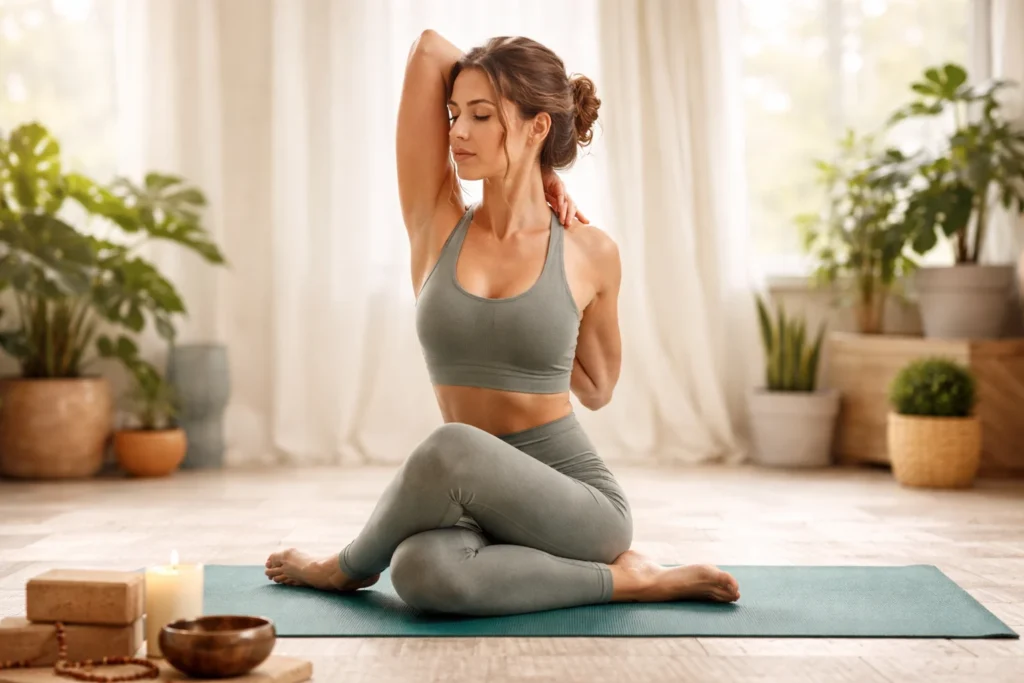
Table of Contents
- Introduction: Gomukhasana (Cow Face Pose)
- What is Gomukhasana (Cow Face Pose)? (Meaning and Background)
- Traditional Significance
- The Importance of Gomukhasana (Cow Face) in Modern Lifestyle
- Why is Gomukhasana(Cow Face Pose) important today?
- The Wide-Ranging Physical Benefits of Gomukhasana
- 4. An improved capacity for airflow
- A Comprehensive Guide to Performing Gomukhasana (Cow Face Pose)
- Most Common Errors During Gomukhasana and How to Prevent Them
- What is the recommended duration and frequency of Gomukhasana (Cow Face)?
- How to incorporate Gomukhasana(Cow Face) into your daily routine?
- Impact on the Mind and Emotions
- Rishikesh Yog Kendra, Yoga School in Rishikesh
- Conclusion
Introduction: Gomukhasana (Cow Face Pose)
Some of the poses in the yoga world progressively show their depth. Among them is Gomukhasana (Cow Face Pose). It seems like a straightforward sitting position, but with patience, you’ll see how much of an effect it has on your spine, shoulders, and hips.
The first time I performed this posture correctly, I realized how chronic the stiffness in my shoulders had become. It wasn’t a painful experience but a moment of awareness—as if the body was saying, “Take care of me now.” Gradually, this posture became a permanent part of my practice.
We shall examine in-depth in this article:
- Gomukhasana: What is it?
- its effects on the body and mind.
- The right way to go about it.
- modifications for novices.
- typical mistakes.
- in addition to commonly asked questions.
What is Gomukhasana (Cow Face Pose)? (Meaning and Background)
The word “Gomukhasana” comes from Sanskrit—
Go means “cow,” and mukha means “face.” Therefore, in this asana, the position of the knees resembles the face of a cow, and the position of the hands resembles its ears.
It is a seated posture in which:
Both legs are crossed, with the knees placed one above the other.
One hand is brought from the top and the other from the bottom, trying to join the fingers.
This posture appears static externally, but internally it activates and stretches many muscles.
Traditional Significance
Hatha Yoga texts consider it a balancing posture. It helps balance the right and left sides of the body and balances the flow of energy. In the tradition of Hatha Yoga, Gomukhasana (cow face pose) is not just considered a physical posture but rather a symbol of balance between the body and energy. Ancient yoga texts place special emphasis on asanas that harmonize the right and left sides of the body, and Gomukhasana falls into that category.
In traditional practice, this asana was often performed before pranayama or meditation. This is because it opens the shoulders and chest and deepens the breath, enabling the practitioner to sit still for longer periods. Ancient yoga masters emphasized that meditative stability comes not only from mental practice but also from physical preparation—and Gomukhasana has been a part of that preparation.
The Importance of Gomukhasana (Cow Face) in Modern Lifestyle
Today, most of us:
- Work on computers all day.
- Stay hunched over mobile phones.
- Spend a lot of time driving.
- None of us exercise frequently.
These habits have a profound impact on our bodies. Gradually, our sitting posture changes—shoulders begin to hunch forward, the chest shrinks, and the back begins to round. On the other hand, constant sitting causes stiffness in the hips and thighs. This is why even young people are complaining of neck pain, shoulder stiffness, and lower back pain.
Gomukhasana directly addresses these problems because it is a posture that simultaneously opens the upper and lower body. When we join hands behind the back in this posture, the shoulders, triceps, and chest area are deeply stretched. This gradually reduces the stiffness caused by prolonged bending.
Why is Gomukhasana(Cow Face Pose) important today?
- To restore shoulder mobility.
- To reduce tension caused by prolonged sitting.
- To prepare the body before meditation and pranayama
- This asana opens the body, but without jerking or intensity.
The Wide-Ranging Physical Benefits of Gomukhasana
The physical benefits of Gomukhasana (Cow Face Pose) are as follows:
1. Deep Stretching of the Shoulders and Upper Back
The most pronounced effect of Gomukhasana is seen on the shoulders and upper back. When one arm is extended from the top and the other from the bottom, it deeply activates the muscles around the rotator cuff, triceps, deltoids, and scapula. This is the area where the most stiffness accumulates these days—especially in people who spend hours working on laptops or mobile phones. Regular practice gradually reduces shoulder stiffness and improves the ability to raise or lower the arms. This can also reduce unnecessary pressure on the neck, relieving cervical tension. After some time, one may feel the shoulders become lighter and more open.
2. More Flexible Hips
The Gomukhasana leg-stacking position, which involves putting one knee on top of the other, has a big effect on the outer hips and glutes. Those who sit for long periods with little movement will greatly benefit from this pose. Apart from making one feel as if they are weightless, enhanced flexibility in the hips makes it easy to sit in meditation poses such as Padmasana and Sukhasana.
3. Enhancing Back Support and Posture
In Gomukhasana, it’s crucial to keep your back straight and your chest up. The importance of maintaining a straight back is emphasized through this exercise, which can be very helpful for people who tend to slouch a lot or have a slight ache in the back. Therefore, regular practice of this exercise will help improve the balance of the body and will result in a noticeable difference in one’s sitting position.
4. An improved capacity for airflow
Breathing becomes slower and deeper as the chest grows. This shift is felt energetically as much as physically. For those who struggle with shallow breathing, this asana can be a good preparatory practice. Doing Gomukhasana before pranayama makes the lungs more receptive and the flow of breath smoother.
5. Stability and Mental Calmness
Although Gomukhasana is a physical pose, it also has a mental effect. To attain this stable pose, one needs to sit still for a while. This stability also calms the mind. The mind slows down when the body is in a stationary position. By focusing on their breathing in this pose, practitioners feel as though they are in a state of meditation.
A Comprehensive Guide to Performing Gomukhasana (Cow Face Pose)
Step 1: Take the initial position.
Sit in Dandasana with your legs straight out in front of you.
Your back should be straight.
Step 2: Positioning the Foot
Position your left foot under your right hip.
Your right foot should be placed over your left knee.
Both knees should be aligned. If you feel unbalanced, sit on a blanket.
Step 3: Hand Position
Raise the right hand.
Bend the elbow and take the hand back.
Take the left hand from the bottom back and interlace the fingers.
If this is not possible, use a strap.
Step 4: Final Position
Chest raised.
Neck straight.
Normal breathing.
Take 5–10 deep breaths.
Most Common Errors During Gomukhasana and How to Prevent Them
1. Pressing Fingers Together
Many people push their hands together, which can cause injury or strain on the shoulders. The best course of action is to gradually decrease the distance while using a strap or article of clothing for support.
2. Bending the Back
A rounding of the back disrupts the balance of the asana. While sitting, practice with your chest slightly raised and your chin straight, maintaining the spine’s natural length.
3. Holding the Breath
People often inadvertently hold their breath when the pose is difficult. Try to maintain slow, deep breathing throughout the entire process—this is what makes the asana comfortable and effective.
What is the recommended duration and frequency of Gomukhasana (Cow Face)?
Beginners:
You don’t need to check your timing if this is your first time striking this pose. Simply hold the pose for 4-5 deep breaths, which is sufficient. When I first started, trying to hold it for longer would result in my body becoming contorted and strained. Gradually, I realized that the goal here isn’t to hold it for a long time but to hold it comfortably.
Intermediate: 30–60 seconds
Once the body has become a little accustomed, hold for half to one minute. Maintain your breathing rhythm during this time and practice both sides equally.
Advanced: 1–2 minutes
Experienced practitioners can hold for longer periods. Longer pauses enhance both deeper stretches and mental stability, provided the body feels comfortable.
Frequency: 3–4 times a week
No need to practice daily. A moderate practice a few times a week is sufficient, especially if you are also doing other yoga asanas.
What conditions should you be cautious about?
If you have:
- Recent shoulder injury.
- Severe knee pain.
- Sciatica.
- Slipped disc.
- Consult a specialist first.
How to incorporate Gomukhasana(Cow Face) into your daily routine?
To be honest, if an asana is to be sustainable in everyday life, it needs to be kept short. Longer routines often get lost after two or three days. I’ve learned this myself—a 10-minute sequence is more sustainable.
A simple and practical sequence:
1. Cat-Cow (Marjari-Bitilasana) – 2–3 minutes
There’s no better way to start slowly mobilizing the spine and combines the movement with the breath, which helps the body get ready for sitting positions and opens the back.
2. Twist gently for two minutes
While seated or in Vajrasana, try a light twist. This lessens upper back and waist stiffness. Sitting in Gomukhasana after the twist feels noticeably easier.
3. Gomukhasana (Cow Face)– 3–4 minutes
Spend equal time on both sides. Try to keep your breath long and calm. Don’t rush here—it’s the core of the entire sequence.
4. One to two minutes for the forward bend
Lastly, the body is balanced by a slight forward bend. This stretches neutrally and calms the mind.
The entire practice can be done comfortably in 10 minutes—before tea in the morning or after work in the evening.
Impact on the Mind and Emotions
Mild emotional sensitivity
Adopting hip-opening poses can cause mild emotional upheaval for some people. This is not unusual—it may be a sign of tension being gradually released from the body.
Peace
Sitting still and breathing deeply allows the mind to slow down. Many people feel a mild peace or clarity within after practice.
Inner Stillness
When the body is still, the attention turns inward. This posture can lead to a sense of inner balance through brief pauses, especially with regular practice.
Rishikesh Yog Kendra, Yoga School in Rishikesh
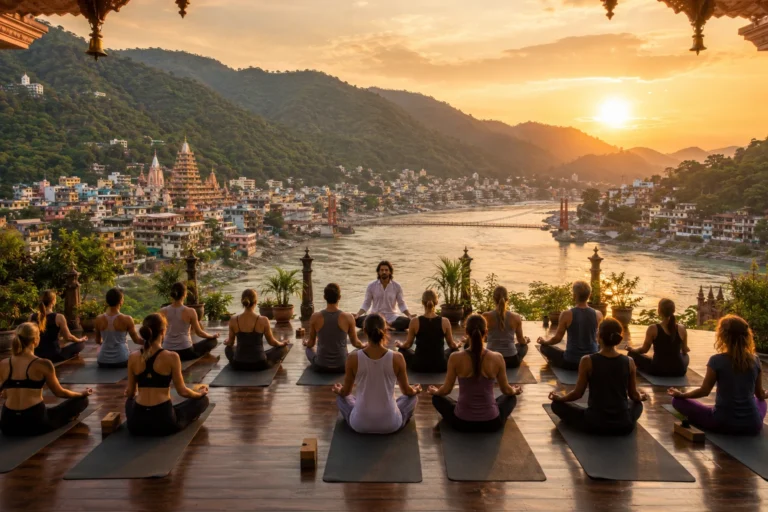
Rishikesh Yog Kendra is one of the renowned yoga schools situated in Tapovan, Rishikesh. Located in the foothills of the Himalayas, along the serene river Ganges, which makes its surroundings serene and peaceful. The environment of this place is very soothing and peaceful, which provides the best surroundings to practice yogasanas. Training in a peaceful place on the banks of the Ganga keeps the mind calm, and focus increases naturally. There are various certified yoga teacher training courses provided by us, including accommodation and three sattvic meals. We also, organize excursions to the beautiful places of Rishikesh to connect you with nature.
- 100-Hour Yoga Teacher Training Course
- 200-Hour Yoga Teacher Training Course in Rishikesh
- 300-Hour Yoga Teacher Training Course
- Sound Healing Teacher Training
- Pre- and Postnatal Teacher Training Course
Conclusion
Gomukhasana (cow face) appears simple from the outside, but when you practice it yourself, its effects gradually become apparent. Initially, the body may feel a little stiff, especially in the shoulders and hips. Sometimes, it feels like we’re not doing it correctly. But as we repeat it slowly and without haste, the body begins to adapt. Gradually, the stiffness begins to ease, and a different kind of stability is felt while sitting.
The best thing about this asana is that it teaches us to pause and pay attention to ourselves therefore, there is no race for a perfect form. You simply listen to your body as you breathe—where there’s tension, where there’s a need for relaxation. This slowness also affects the mind. After a few minutes of practice, you begin to feel a slight peace within, as if your mind has become a little lighter.