Español


What is Bhramari Pranayama? Benefits, Method, and Correct Way to Do It
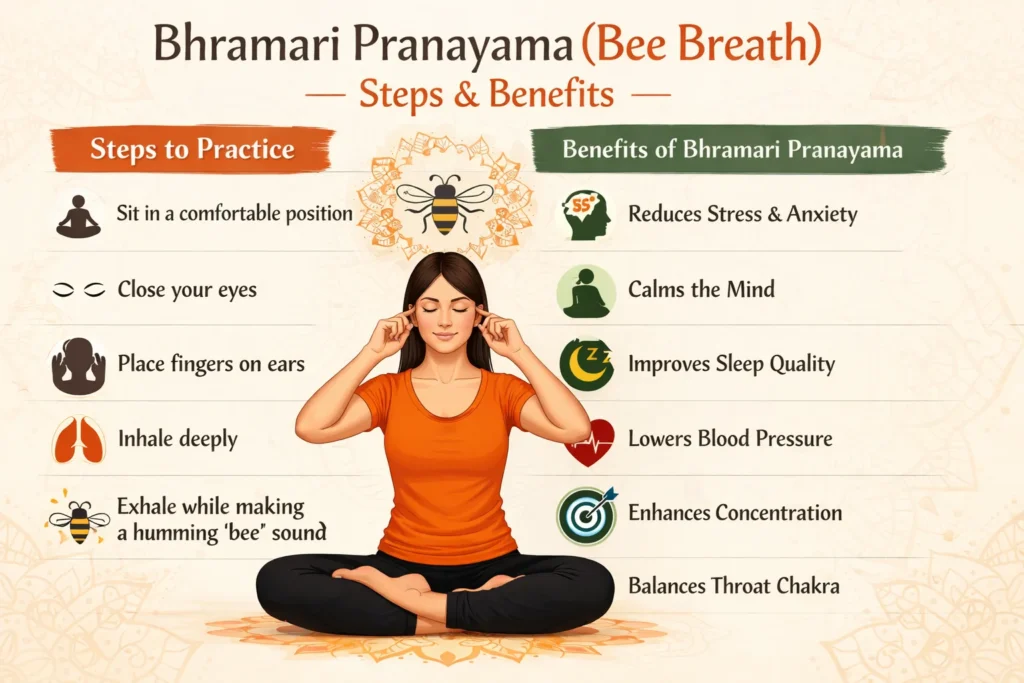
Table of Contents
- Introduction – Bhramari Pranayama
- What is Bhramari Pranayama?
- Why is Bhramari so effective?
- Benefits of Bhramari Pranayama
- 5. Reducing head and face tension
- How to Perform Bhramari Pranayama (Step-by-Step)
- Common Mistakes to Avoid
- The right time to practice Bhramari
- Who can do Bhramari Pranayama?
- A 30-Second Human-Touch Trick
- A Balanced Approach
- Rishikesh Yog Kendra—Yoga School in Rishikesh
- Conclusion
- FAQs—Questions about Bhramari Pranayama
Introduction – Bhramari Pranayama
Some breathing exercises take time to understand, some seem very technical, and some require specialized practice. However, bhramari pranayama is a practice that is extremely simple, intuitive, and yet deeply effective. This is why it is becoming increasingly popular in today’s stressful lives.
It’s called “buzzing bee breathing” because it makes a bee-like “mmm…” sound while exhaling. It may feel a little strange the first time you do it—after all, we don’t make a sound while exhaling in normal life. But as you complete 4-5 rounds, you’ll begin to feel a slight peace and calm.
The most important feature of Bhramari is that it doesn’t force the mind to calm down. It gradually creates a calming atmosphere within. The vibrations produced by long, slow breathing signal relaxation to the brain and nervous system.
What is Bhramari Pranayama?
Bhramari Pranayama is a traditional yogic breathing technique that involves creating a bee-like humming sound while exhaling. The word “Bhramari” comes from the Sanskrit word “bhramara,” meaning bee. Unlike other pranayamas, it doesn’t require breath-holding or complex counting. Its focus is sound and awareness. This sound allows the mind to focus on a single point, which makes it easier to feel inner peace.
This sound was traditionally used before meditation. However, nowadays, it is also used by many people to relieve stress, improve sleep, and balance the mind.
Best of all, it doesn’t require any special yoga experience to learn.
Why is Bhramari so effective?
On the surface, this may seem like a simple practice. But it has a strong scientific and empirical basis.
When we hum, it creates a gentle vibration in the body. This vibration stimulates the vagus nerve, which is linked to the parasympathetic nervous system. The parasympathetic nervous system is known to relax the body, decrease heart rate, and relieve stress.
Additionally, humming focuses the mind on a single sound. This helps clear the clutter of thoughts. This combination—physical calmness and mental focus—makes Bhramari instantly effective.
Some people even call it the “reset button for the nervous system.”
Benefits of Bhramari Pranayama
Regular practice has been shown to have a variety of mental and physical benefits.
1. Reduction in stress and anxiety
When we practice Bhramari Pranayama and exhale with a melodious “mmm…” sound, the vibrations have a positive effect on our brain and nervous system. This process puts the body into “relax mode.”
2. Improves attention and concentration
When you perform Bhramari Pranayama and slowly exhale with the sound “mmm…”, subtle vibrations are created in the brain. This vibration helps reduce mental chatter.
3. Better sleep
When we exhale slowly and make a melodious sound of “mmm…” during Bhramari Pranayama, this vibration directly impacts the brain and nervous system. This sound creates inner peace, not external—as if signaling to the brain that it’s time to relax.
4. Emotional balance
Emotional ups and downs are a part of life. Sudden outbursts of anger, small upsets, feeling restless or irritable—these are all signs that our minds are out of balance. In such situations, bhramari pranayama can be a simple and effective practice to bring about emotional stability.
5. Reducing head and face tension
Staring at a mobile or computer screen for long periods of time, work pressure, lack of sleep, and mental stress can all strain the muscles of the head and face. This results in heaviness, headaches, eye strain, and facial fatigue. In such situations, bhramari pranayama can prove to be a simple yet effective relief exercise.
6. Preparation for meditation
The biggest problem when trying to meditate is the lack of calmness in the mind. As soon as one sits down, thoughts begin to rush. This makes it difficult for many people to settle into meditation. This is where bhramari pranayama serves as an effective preparation technique.
7. Improving the Mind-Body Link
Actually, we tend to treat our body and mind as two different things. However, the fact is that they are closely interlinked. When our mind is stressed, our body becomes stiff, and when our body is exhausted, our mind becomes heavy. In such situations, the best way to improve the mind-body link is to perform bhramari pranayama.
How to Perform Bhramari Pranayama (Step-by-Step)
This exercise is quite easy, but it is essential to perform it correctly.
Step 1: Select a quiet place
Sit in a quiet place.
Step 2: Comfortable posture
Sit in an upright position, either on the floor or on a chair, with your back straight but not tense.
Step 3: Close your eyes.
Take a few regular breaths and relax your body.
Step 4: Alternative Pose
This exercise can be performed with your ears slightly closed (Shanmukha Pose), but it is better to perform it in the normal position.
Step 5: Breathe slowly
Take a deep but smooth breath through your nose.
Step 6: Repeat
Do 5 rounds initially, then gradually increase to 10–15.
Common Mistakes to Avoid
Despite simple exercises, some mistakes can diminish their effectiveness.
- Humming too loudly
- Expiring too quickly
- Practicing in a noisy environment
- Stressing too much about technique
The basic mantra of Bhramari is simplicity.
The right time to practice Bhramari
The beauty of it is that it can be done at any time of the day.
Morning: For a calm start to the day
Afternoon: For a reset amid mental fatigue
Evening: To reduce the stress of the day
Before bed: For better sleep
Before meditation: To prepare the mind
Many people experience the most benefits when they practice it amid stress
Who can do Bhramari Pranayama?
It is suitable for people of almost all ages.
Especially useful for:
- For beginners in yoga
- For those struggling with stress or anxiety
- For students
- For those just starting out in meditation
However, those with severe ear infections or respiratory problems should consult a specialist
A 30-Second Human-Touch Trick
If you want to make this practice more personal, try this small experiment.
Before you begin, ask yourself:
“How am I feeling right now?”
Then repeat the same question after the practice.
This is what makes the practice an experience, not just a technique. Slowly, you begin to observe the changes that are taking place within.
A Balanced Approach
It is very important to keep in mind that Bhramari is not a magic wand. It is not a solution that will change your life in an instant, but a simple practice that will work wonders. It’s not an instant, life-changing solution, but rather a simple, supportive practice. But its true power lies in its simplicity. When life gets complicated, a practice that can provide relief in just a few minutes is the one that lasts. Sometimes, small, regular practices are more effective than major changes.
Rishikesh Yog Kendra—Yoga School in Rishikesh
Rishikesh Yog Kendra is widely recognized as one of the best yoga schools in Rishikesh, The school offers Yoga Alliance–certified teacher training programs (100, 200, 300, and 500 hours), along with Aerial Yoga, Prenatal & Postnatal Yoga, and short retreats. The curriculum moves beyond physical postures. It provides accommodation along with the three-time sattvic meal to all the students. It may not be luxurious, but it feels grounded. Students of different ages and backgrounds share the same routine—early mornings, focused classes, simple meals, and thoughtful discussions. If someone is researching yoga teacher training in Rishikesh and prefers a traditional yet structured learning environment, this school is worth looking into without expecting hype.
- 100-hour yoga teacher training
- 200-hour yoga teacher training course in Rishikesh
- 300-hour yoga teacher training
- Pre and Postnatal Yoga teacher training
- Sound Healing Teacher Training
Conclusion
Bhramari Pranayama teaches us a very important thing—that sometimes we don’t need complex techniques or a lot of time to attain bliss. Sometimes, all we need is a deep breath, an exhale with an “mmm…” sound, and a few minutes of mindfulness.
The uniqueness of Bhramari is that it doesn’t try to forcefully calm the mind. It gradually reduces mental agitation. As you continue to practice, you will find that the intensity of stress is reducing, the flow of thoughts is slowing down, and a sense of calm is developing inside.
This process affects the body and mind at the same time. The waves emit soothing messages to the nervous system, which enables the body to relax and the mind to calm down. This is why it can be done before meditation, before bed, or during any stressful situation.
Most importantly, there’s no need to perfect Bhramari. Even a few minutes of practice daily can have profound long-term effects.
If you’re looking for a breathing exercise that’s simple, safe, and can be done regularly, Bhramari Pranayama is an excellent choice. It’s not a passing trend but a peaceful practice—one that shows its effects in a timely, silent, and lasting way.
FAQs—Questions about Bhramari Pranayama
Q. How long should you practice Bhramari daily?
Ans. Start with 5 rounds. Gradually increase to 10–15 rounds.
Q. Can beginners do it?
Ans. Yes, it’s one of the easiest pranayama exercises.
Q. Is it better than meditation?
Ans. Not better or worse—but it makes meditation easier.
Q. Can it be done lying down?
Ans. Yes, especially before sleeping. But doing it while sitting is more effective.
Q. Does it help with anxiety?
Ans. It may help with mild anxiety, but in severe cases, expert advice is necessary
Q. How long does it take to see results?
Ans. Many people feel peace immediately. Deeper benefits come with regular practice.