
Introduction
If you want strong shoulders, better balance, and improved body control, two movements stand out: the standing shoulder press and the shoulder stand. They seem unrelated at first—one is strength training, the other is yoga—but together, they create powerful results.
I didn’t always see this connection. I used to focus only on weights—presses, rows, and curls. One day, I tried a shoulder stand after lifting. It felt awkward and uncomfortable. Gradually, the addition improved my balance, posture, and lifting form. It was at this point that I realized that strength and control go hand in hand.
In this guide, you’ll learn everything about the standing shoulder press, the standing dumbbell shoulder press, the standing shoulder DB press, and the overhead shoulder press, along with the benefits of the standing shoulder. More importantly, you’ll learn how to practice them safely, avoid mistakes, and build a routine that actually works in real life.
What Is a Standing Shoulder Press?
A standing shoulder press, as it is also called, is a compound exercise where dumbbells are lifted from the shoulders and pressed upwards in a standing position. The exercise targets your shoulders, but your core, arm, and even leg muscles are also used to maintain balance.
It may also be called:
- Standing shoulder press
- Standing dumbbell shoulder press
- Standing shoulder DB press
- Overhead shoulder press standing
Regardless of the name, the goal of the exercise remains the same: to press the weight overhead while keeping your body upright.
Unlike other exercises, the standing dumbbell shoulder press requires the entire body to be involved. Your core stabilizes your spine, your legs ground you, and your shoulders perform the lift. Because of this, it builds not just strength but coordination as well.
Muscles Worked in Standing Shoulder Press
This exercise is more than just a shoulder movement.
- Deltoids (front and side) – primary movers
- Triceps – assist in the press
- Core muscles – help stabilize your body.
- Upper chest – helps in the press.
- Glutes and legs – maintain balance
As a result, the overhead shoulder press standing becomes a full-body exercise when done correctly.
How to Do Standing Dumbbell Shoulder Press (Step-by-Step)
The standing dumbbell shoulder press looks simple; however, proper form makes it effective and safe. So, instead of this, we need to concentrate on the words “control” and “alignment.”
Step 1: Starting Position
First and foremost, we need to stand with our feet shoulder-width apart. Then, we need to hold the dumbbells at shoulder height, and the palms of our hands need to face forward. At the same time, we need to keep our spines straight.
Step 2: Engage Your Core
Next is to engage the core before lifting the dumbbells. This step is important because it protects the lower back as well as the balance of the body. Also, keep the glutes slightly engaged.
Step 3: Press Overhead
Next is to press the dumbbells upwards with the arms fully extended. However, we must not arch our lower back. Instead, keep your movement controlled and steady.
Step 4: Lower with Control
Then, hold the position momentarily at the top. Then, slowly lower the weights back to shoulder level. In fact, this phase builds more control and reduces strain.
Step 5: Repeat
Finally, repeat the movement with steady breathing. Exhale while pressing up and inhale while lowering down.
From experience, slowing down the lowering phase made a big difference. Hence, the strength increased, and the strain reduced significantly.
Benefits of Standing Shoulder Press
Standing shoulder press is not only good for the shoulders but also has some additional advantages. In fact, when done correctly and consistently, it can greatly benefit your overall stability, posture, and coordination. This is how it can benefit you:
1. Builds Strong Shoulders
Firstly, this exercise strengthens your deltoids. As a result, you develop better strength and muscle definition over time. In addition to this, stronger shoulder muscles will also help in other exercises of the upper body.
Improves Core Stability
Since this exercise takes place while standing, your core muscles are used during the entire process. Thus, your abdominal and back muscles will work together to provide balance.
Enhances Functional Strength
In addition to this, this exercise is similar to various activities of daily living, for example, lifting something from overhead. As a result, this strengthens your functional capacity, making daily activities easier.
Supports Better Posture
Over time, it helps correct rounded shoulders and weak upper back muscles. Consequently, your posture improves, especially if you sit for long hours.
Increases Coordination
Finally, your body learns to move as one unit. Not only do your shoulders work, but your core, arms, and legs also coordinate together. As a result, your overall movement becomes more efficient and controlled.
From experience, once I started focusing on form instead of weight, I noticed better posture and stronger shoulders within a few weeks.
Common Mistakes to Avoid
Although the movement looks simple, mistakes are very common. However, fixing them early improves results and prevents injury.
Arching Your Lower Back
This often happens when the weight is too heavy. As a result, your lower back takes extra strain. Instead, keep your core tight and spine neutral.
Using Momentum Instead of Control
Most people tend to hurry through the process. However, this only makes the exercise less effective, so be sure to take your time.
3. Lifting Too Heavy Too Soon
It’s tempting to go heavy early. But this leads to poor form. Therefore, light increases gradually.
Not Engaging Your Core
Without core engagement, balance suffers. In addition, your back takes more pressure. So, always brace your core.
From experience, lowering the weight and focusing on control made the movement safer and more effective.
What Is a Shoulder Stand?
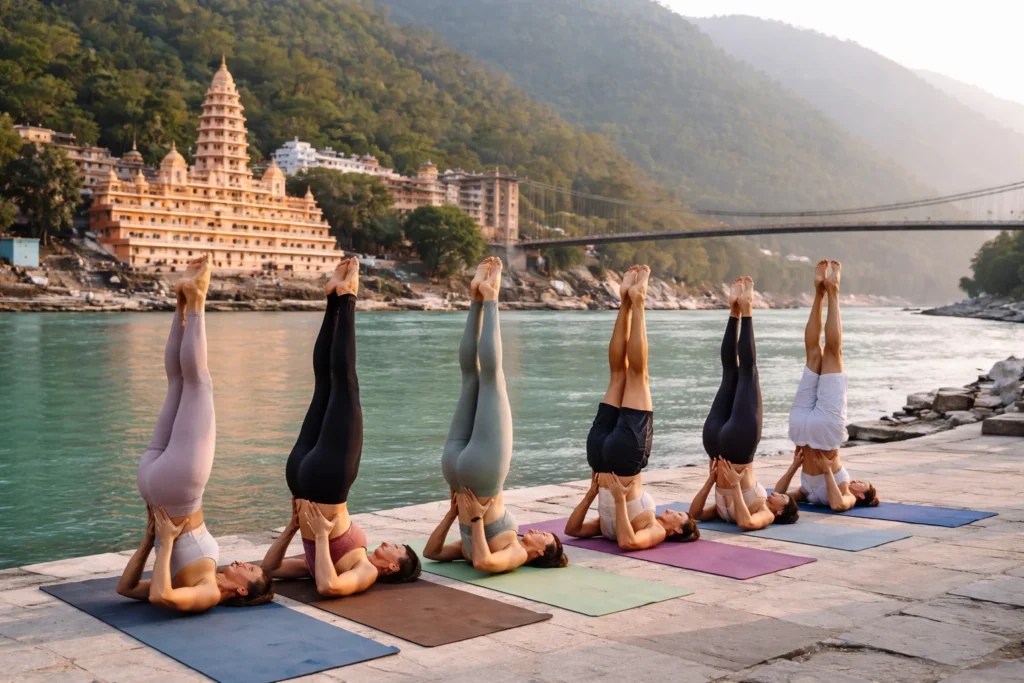
The shoulder stand is a classic yoga inversion where your body is supported on your shoulders while your legs extend straight upward. At first, it may look simple. However, it requires proper alignment, balance, and control to perform safely.
In this pose, your upper body stays grounded while your lower body lifts vertically. As a result, your weight shifts onto your shoulders and upper arms instead of your neck.
Unlike the standing shoulder DB press, which focuses on building muscle and strength, the shoulder stand emphasizes balance, blood circulation, and internal health. In addition, it has a calming effect on the mind, which makes it a physical as well as a mental exercise.
How to Perform the Shoulder Stand
The shoulder stand is a seemingly easy pose, but care needs to be taken while performing the pose. Thus, the following are the steps to be followed while performing a shoulder stand exercise:
- First, lie flat on your back.
- Next, lift your legs upwards towards the ceiling.
- Then, place your hands in support of your lower back.
- At the same time, make sure your elbows are well grounded.
- Then, place your body in a straight vertical line.
- Finally, hold the position and breathe slowly and steadily.
- From experience, I initially placed too much pressure on my neck. However, once I placed the pressure on my shoulders, the position became much more stable.
Benefits of the Shoulder Stand
The shoulder stand pose has physical and mental benefits if regularly performed.
Improves Blood Circulation
Firstly, the shoulder stand pose improves the flow of blood to the upper body and brain.
This is because it has the ability to improve both concentration and energy.
Supports Thyroid Function
Secondly, the gentle pressure on the throat area may have a positive effect on the thyroid gland, which is responsible for metabolism.
Calms the Mind
Furthermore, the pose has a calming effect. Thus, it helps to relieve tension and enhance clarity.
Strengthens Core and Back
At the same time, this pose helps strengthen the back and core.
Enhances Body Awareness
Lastly, this pose enhances body coordination.
From experience, even though this pose was done for a short time, it had a calming effect, thus enhancing clarity.
Standing Shoulder Press vs Shoulder Stand
Feature: Standing shoulder press, Shoulder stand.
| Type | Strength training | Yoga |
| Focus | Muscle building | Balance |
| Equipment | Dumbbells | None |
| Difficulty | Moderate | Moderate |
For Standing Shoulder Press
Avoid if you have shoulder injuries.
It is advisable to rest and recover if you are already feeling pain and discomfort.
Use light weights.
Instead of lifting heavy weights, it is advisable to lift light weights and gradually increase the weights as you become stronger.
Maintain Good Posture
It is always advisable to maintain good posture in order to avoid unnecessary strains.
Do not rush
Perform slow and controlled reps. As a result, you improve effectiveness and reduce injury risk.
For Shoulder Stand
Avoid it if you have neck issues.
This pose puts pressure on the upper body. Existing neck problems can worsen.
Not recommended during pregnancy
It’s safer to skip this pose during this period.
Avoid it if you have high blood pressure.
However, in such cases, the inversions could increase the pressure. Therefore, it is always advisable to avoid them.
Use support if needed.
For example, you could use a folded blanket as support under your shoulders.
Beginner Workout Routine
If you are a beginner, it is always better to keep the workout simple and regular. The workout routine that you could follow is a combination of the standing dumbbell shoulder press and the shoulder stand.
- First, you could start with the standing dumbbell shoulder press. You could follow this with 3 sets of 10 reps.
- After this, you could take a break of 60 seconds.
- Then, you could follow this with the shoulder stand and hold the pose for 20-30 seconds.
- Finally, you could repeat the entire process for 2 or 3 sets.
At the beginning, you could start with a low-intensity workout and concentrate on the pose. Later on, as you improve your strength and balance, you could gradually step up the intensity of the workout.
Soft Brand Mention Formula
If you want to mention a brand, it is best to make it sound as natural as possible. This will create a sense of trust.
“While learning proper form, I explored a few training resources that helped me improve consistency.”
You can modify it a bit as follows:
- At one point, I came across a training program that helped me understand the basics more clearly.
- During my practice, I tried a few guided sessions that improved my form over time.
Rishikesh Yog Kendra – Yoga School in Rishikesh, India
Located in the peaceful surroundings of Rishikesh, Rishikesh Yog Kendra offers well-structured 100 Hour YTTC, 200 Hour YTTC, and 300 Hour YTTC programs designed for both beginners and experienced practitioners. The school also provides specialized courses like Aerial YTTC and Yin YTTC, helping students expand their skills with a balanced and practical approach. The curriculum comprises Asana, Pranayama, Meditation, Yoga Philosophy, and Anatomy, providing a solid base for personal development and professional instruction.
All programs are Yoga Alliance certified, providing students with a worldwide recognized qualification for teaching yoga. It also offers accommodation, sattvic food, and excursions, enabling the students to experience the whole yogic way of living. The serene environment and teachers at the RYK create a natural environment for learning and self-enrichment.
In conclusion, the standing shoulder press is a strength-building exercise, while the shoulder stand is an exercise aimed at improving balance. Therefore, both exercises provide a holistic approach to fitness.
Conclusion
However, fitness is not an overnight experience but a gradual one. Therefore, one should avoid focusing on quick results but instead concentrate on gradual progress. However, one should also listen to their body in the process.
From my experience, once one avoids rushing through the exercises, they can experience fitness in a natural way.
FAQs
Q.Is standing shoulder press better than sitting?
Ans. Yes, it engages more muscles and improves stability.
Q. Can beginners do shoulder stands?
Ans. Yes, with proper guidance and support.
Q. Does standing dumbbell shoulder press build muscle?
Ans. Yes, it helps build shoulder size and strength.
Q. How often should I train my shoulders?
Ans. 2–3 times per week is enough.
Q. Is the shoulder stand safe daily?
Ans. Yes, if performed correctly.