Español


Shirshasana (Headstand Pose): Benefits and Step-by-Step Guide
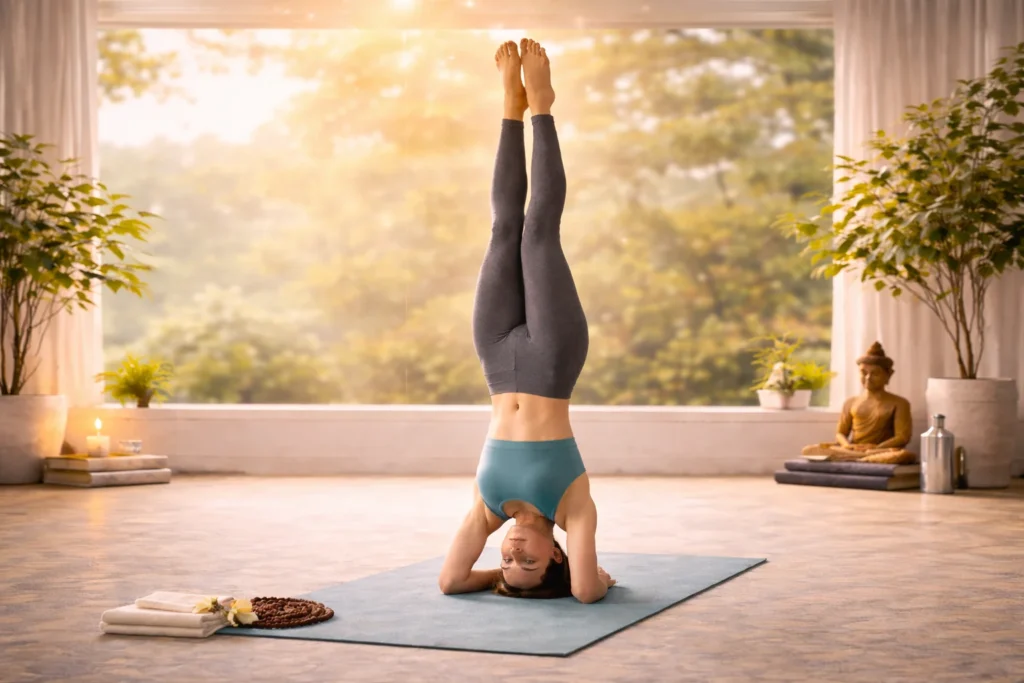
Table of Contents
- Introduction: Shirshasana (Headstand Pose)
- What is Shirshasana (Headstand Pose)?
- The Role of Shirshasana in Yoga Practice
- Shirshasana (Headstand Pose) Benefits
- 5. Develops Balance and Body Awareness
- The Correct Method for Doing Shirshasana (Headstand Pose)
- Tips for Beginners
- Precautions While Practicing Shirshasana
- Common Mistakes
- Personal Experience
- Rishikesh Yog Kendra—Yoga School in Rishikesh
- Conclusion
- FAQs
Introduction: Shirshasana (Headstand Pose)
In the context of yoga, there are some poses that have a significant impact on the body as well as the mind. Therefore, the “Headstand Pose,” or “Shirshasana,” holds significant importance. In fact, this pose has been termed the “King of Asanas” in many forms of yoga. Thus, the importance of this pose does not lie only at the level of the difficulty factor but also at the level of the benefits that the practitioner derives from this pose.
In the fast-paced and hectic lifestyle of the present day, it is quite common to experience fatigue, stress, and lack of focus in life. Thus, it may be stated that the term “yoga” transcends the limits of the physical activity that is encompassed under this term. The “Shirshasana” holds significant importance as a pose that not only tests the limits of the practitioner.
Though this pose may seem somewhat challenging at the very outset, it may be mastered with the help of consistent practice and patience.
This article will take a closer look at:
- What Shirshasana actually is
- The advantages of practicing Shirshasana
- A detailed guide on how to do it
- Helpful hints for those just starting out
- Some things to watch out for, and common errors to avoid
What is Shirshasana (Headstand Pose)?
Shirshasana, a yoga pose, is named after the Sanskrit word “Shirsha,” which means “head.” “Asana” refers to a position, a sitting posture, or a particular state of the body. Shirshasana, therefore, literally means “the posture of standing on one’s head.” Shirshasana is also called “Headstand Pose.”
In traditional yoga, Shirshasana is an important inversion pose. Shirshasana is a pose in which the body is inverted. This means that in Shirshasana, the head is placed in a downward direction, and the feet are placed in an upward direction. This pose may seem quite difficult at first, but with practice, it can definitely be mastered.
For this reason, Shirshasana is also called “the King of Asanas.” Shirshasana is not just an asana; it is a pose that helps in maintaining balance, concentration, and mental equilibrium.
The Role of Shirshasana in Yoga Practice
In the practice of yoga, inversion poses are extremely important. When the body is inverted, the force of gravity exerts a distinct influence upon it. Consequently, the distribution of blood circulation may shift, and blood flow to the brain may experience a slight increase. Moreover, in order to maintain the equilibrium in this posture, the mind needs to be totally focused. Therefore, it is the belief of most yoga practitioners that the practice of yoga helps in the improvement of mental clarity as well as concentration.
Moreover, Shirshasana involves the usage of various parts of the body, such as the shoulder muscles, the arms, and the abdominal muscles, as well as the back muscles. The usage of these muscles in an appropriate manner helps in the improvement of the overall stability of the body. The gradual practice of Shirshasana helps in the improvement of the flexibility as well as the strength of the body. Shirshasana is mostly practiced in the middle or the concluding part of the practice of yoga, as the body is already in motion in most of the yoga practices. Therefore, the practice of Shirshasana helps in the improvement of the overall stability of the body, as well as the development of mental clarity and self-confidence.
Shirshasana (Headstand Pose) Benefits
1. Stimulates Blood Circulation
First and foremost, it should be noted that this pose has been recognized to stimulate blood circulation in the body. In this pose, the blood flow to the face increases. It is this benefit that has often left many with a rejuvenated feeling after practice.
2. Enhances Concentration and Mental Clarity
In this pose, it is important to maintain balance; hence, it enhances concentration. An individual can improve his or her concentration levels by frequently undertaking this pose.
3. Strengthens Shoulders and Arms
Even though it is referred to as the “head-standing” pose, it should be noted that the arms are also utilized; hence, it strengthens the muscles in the arms.
4. Boosts Energy Levels
Based on the experiences of many yoga enthusiasts, it has been noted that after undertaking this pose, the body tends to feel energized. In fact, it has been noted that undertaking this pose in the morning can leave an individual with a feeling of freshness.
5. Develops Balance and Body Awareness
Furthermore, this asana aids in improving the body’s sense of balance and control. Gradually, the practitioner begins to perceive and understand their bodily movements with greater clarity and precision.
6. Helps Improve Body Posture
One of the benefits associated with the practice of Shirshasana is its ability to improve the posture of the body. When performing the Shirshasana, the spine must always remain straight. As a result, the body becomes accustomed to maintaining the right posture.
7. Can Help Boost Self-Confidence
It is likely for a person to feel a sense of fear or apprehension when they attempt to perform the Shirshasana. However, as the person gradually becomes able to balance their body, their level of confidence increases. This explains why many people consider the Shirshasana to be a confidence-building pose.
8. Enhances Body Flexibility and Control
The practice of the Shirshasana improves the flexibility and control of the body. To maintain balance in this pose, the muscles throughout the entire body must work in unison. As a result, the body’s overall coordination may gradually improve.
The Correct Method for Doing Shirshasana (Headstand Pose)
Step 1 – Choose the Right Location
First, select a quiet and clean space. Kneel down on a yoga mat and give your body a chance to rest for a moment. If you are a beginner, it would be advantageous to practice near a wall.
Step 2 – Hand Placement
Now, place your hands on the ground by joining the fingers of both hands. After that, place your elbows apart by the width of your shoulders.
Step 3 – Head Placement
Then, gently place the crown of your head on the ground. Your interlocked fingers should be providing support to the back of your head.
Step 4 – Lift the Hips
Next, lift your hips upward. While doing so, your legs should be straight. When you are in this position, your body should be in the form of an inverted letter ‘V.’
Step 5 – Lift the Legs
After that, you should slowly move your feet towards your head. Then, you should lift your legs upward, one at a time.
Step 6 – Hold the Full Pose
Once you are in balance, you should extend your legs upward and in a straight line. While in the pose, breathe slowly and deeply.
Step 7 – Return Slowly
While coming back to the initial position, you should not rush. So, you should bend your knees and then move your feet back to the ground.
Tips for Beginners
If you are practicing the Headstand Pose (Shirshasana) for the first time, there are certain tips that can be followed to practice it correctly. Patience is very important in the initial stages, as it requires proper balance, strength, and technique.
- Practice against the wall.
- Do not try to rush the process.
- First, build strength in your shoulders and arms.
- Learn under the supervision of a yoga instructor.
Additionally, performing a light warm-up before practice is very important. For instance, practicing a few simple yoga poses that activate the shoulders, neck, and back helps prepare the body. This will also prevent injuries.
Based on my personal experience, in my initial stage of learning how to practice Shirshasana, it was quite difficult to balance my body in that position. It was quite difficult to hold the position for a few seconds. However, with practice and proper guidance, the body slowly starts to get used to the position.
The most important thing is to understand the limitations of the body and slowly start to increase the level of practice. With time, the body will become more confident in the posture, and the practice of Shirshasana will become more stable.
Precautions While Practicing Shirshasana
Though there are various benefits of practicing Shirshasana, it is quite crucial to observe certain important precautions while practicing this posture. As it is an inverted posture, there is a chance of increased pressure on the neck, shoulders, or back if the posture is not practiced properly.
You should avoid practicing this pose in the following situations:
- When you are experiencing neck pain or injury
- When you are experiencing high blood pressure
- When you are experiencing serious eye problems, like glaucoma
- When you have recently undergone surgery
- When you are experiencing dizziness and problems related to balance
Also, it is recommended that you only practice this pose after warming up. It is beneficial to activate the shoulder, arm, and torso muscles, as it helps in preparing the body for the pose. It is recommended that you practice this pose in front of a wall, especially if you are a beginner. This helps in reducing the fear of falling and makes it easier to learn how to balance yourself. If you are feeling pressure in the neck, you should immediately exit the pose and rest for some time.
Most importantly, the pose should be practiced with patience and correct techniques. It is possible to develop the required strength and balance in the pose by gradually increasing the level of practice.
Common Mistakes
Attempting to Balance Too Quickly
Many people try to assume the pose immediately, even at the beginning. However, doing so can disrupt their balance.
Excessive Pressure on the Neck
If the entire body weight is placed on the head, it can lead to increased strain on the neck. Therefore, it is essential to keep the shoulders and arms engaged.
Holding One’s Breath
There are people who hold their breath when they try to maintain balance, but it is better to breathe slowly.
Personal Experience
It has been an interesting and enriching experience for me to learn Shirshasana, also known as Headstand. In the beginning, this pose appeared to me to be a little intimidating, as it was a new kind of experience for me to balance on my head. But as I began to practice this pose slowly, I learned that in order to maintain balance, it is not just important to have physical strength but also patience, correct technique, and self-confidence.
Initially, I was able to maintain this pose for a few seconds, but with the support of the wall. But as I continued to practice, my body began to develop strength, and I started to develop balance. I slowly began to understand that it takes some time for the body to adapt to this pose, and therefore, instead of hurrying, it is better to practice it slowly and steadily.
At times, even holding this position for just a few seconds instills a unique sense of tranquility in the mind. It feels as though a state of meditation has begun to unfold quite naturally. This could be the reason why most people practicing yoga consider that Shirshasana is not only an exercise, but it is also an experience that helps one achieve mental balance. The more one practices, the more they get used to this pose, and it becomes easier.
Rishikesh Yog Kendra—Yoga School in Rishikesh
Rishikesh Yog Kendra is a haven for those who want to deepen their understanding of yoga even more and live its essence in this beautiful and spiritual town of Rishikesh. The yoga school offers a range of teacher training courses, such as 100-hour yoga teacher training in Rishikesh , 200-hour YTTC, and 300-hour yoga teacher training course in rishikesh, as well as other short courses such as Aerial Yoga TTC and Sound Healing YTTC in Rishikesh. These courses are helpful for beginners as well as those seeking to enhance their knowledge and become better teachers.
The course consists of necessary components like asana practice, pranayama, meditation, yoga philosophy, and teaching methods. After the completion of the course, one gets a certification that is recognized internationally by Yoga Alliance. Along with the acquisition of knowledge, one also gets the opportunity to experience the peaceful surroundings of Rishikesh and sattvic food, which is healthy and helps create a conducive environment for one to develop and discover themselves.
Conclusion
Shirshasana is an advanced pose that is effective in the practice of yoga. It tests one’s physical, mental, and balancing abilities. Even though it takes time to master, one can learn and practice it safely.
Most importantly, one should not try to learn any pose in haste. It is much better and safer to practice it gradually. When the individual practices with patience, the body gradually begins to become stronger and more balanced.
Furthermore, Shirshasana is not merely an exercise in physical strength; it can also help make the mind more focused and calm. With regular practice, an individual becomes increasingly aware of their body’s balance, breath, and mental state.
Finally, if the right approach, care, and practice are followed, the Headstand Pose (Shirshasana) can become a very important and balancing component of one’s yoga practice. Thus, when you are learning it, you should exercise patience, and you should also respect your limitations as you go through the practice.
FAQs
Q1: What is Shirshasana?
Ans: It is one of the yoga poses in which an individual stands on his or her head and hands.
Q2: What are the benefits of Shirshasana?
Ans: The benefits of Shirshasana include good blood circulation, balance, concentration, and energy.
Q3: How should one practice Shirshasana as a beginner?
Ans: It is recommended that an individual should practice it in front of a wall.
Q4: How long should one hold the headstand pose?
Ans: One should hold it for 5-10 seconds.