Español


How to Do Navasana: Ardha & Paripurna Navasana Guide
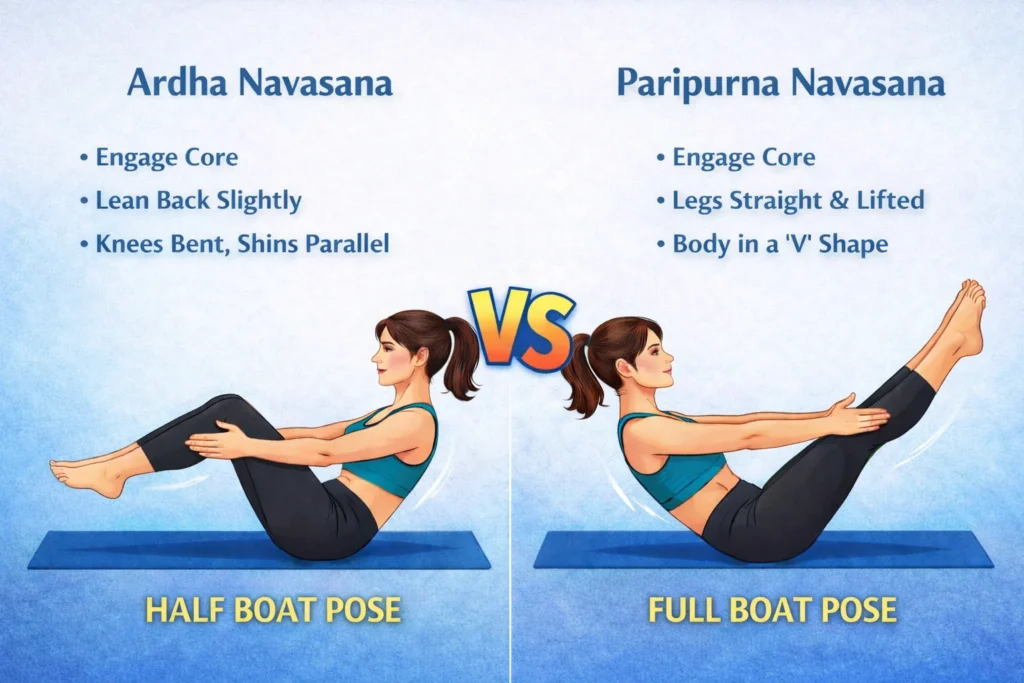
Table of Contents
- Introduction: Navasana
- What is Navasana?
- Ardha Navasana (Half Boat Pose)
- 2. Improves Balance and Stability
- How to Do Navasana Pose
- How to Do Ardha Navasana (Half Boat Pose)
- How to Do Paripurna Navasana (Perfect Boat Pose)
- Difference between Ardha Navasana and Paripurna Navasana
- Common Mistakes When Performing Navasana Pose
- Precautions
- Contraindications (Conditions not to be practiced)
- Tips to Improve Practice
- Rishikesh Yog Kendra – Yoga School Rishikesh
- Conclusion
- FAQs (Frequently Asked Questions)
Introduction: Navasana
Yoga is not merely for developing flexibility in the body. Rather, it is an ancient practice that balances the body, mind, and breath. When you practice many yoga postures, they may seem simple, but you achieve their depth. Navasana is one of those postures.
When first attempting the Navasana pose, it appears very simple, as if you only need to lift the legs and lean the body back slightly. Yet, once you attempt to hold this position, the abdominal muscles engage, and maintaining balance quickly becomes a challenge.
I remember the first time I practiced Navasana. Initially, I thought it would only take five seconds. But as soon as I lifted my legs, my body began to tremble slightly. That day, I learned that many yoga postures may seem simple, but their results are profound.
What is Navasana?
Navasana is a word that is composed of two other words:
- Nava – boat
- Asana – sitting or standing posture
When you balance this posture, it resembles a boat. Therefore, people know it as Boat Pose in English. The pose primarily strengthens the abdominal muscles, but it does not limit its effects to them.
This posture:
- Improves balance
- Strengthens the spine
- Increases focus and concentration
- Improves body stability
In the yoga tradition, this posture is often practiced to strengthen core strength and activate the digestive system.
Paripurna Navasana (Full Boat Pose)
There are two main types of Navasana:
Ardha Navasana (Half Boat Pose)
Although both postures serve the same purpose, their techniques differ slightly, which is important when choosing which version to practice.
Understanding the Navasana Position
To perform any yoga asana correctly, it is essential to understand its structure. In the Navasana position, the body’s balance rests primarily on the sitting bones.
In this position:
- The body is slightly bent back.
- The feet are raised off the ground.
- The arms are extended forward.
- The spine is straight.
When this balance is achieved correctly, the body forms a V shape.
This asana, being a yoga pose, is not just about practicing how to raise the legs, as is commonly believed, but is actually a practice of core stability and control, and if the core is not engaged, the body will be unstable.
Key Benefits of Navasana Pose
There are many benefits of practicing the Navasana pose regularly, and it is good for both the body and mind. This pose is particularly good for strengthening the core, as well as improving balance and body stability.
1. Strengthens Core Muscles
Navasana pose is an effective yoga posture that activates the deep abdominal muscles. As you balance your body in Navasana pose, you are strengthening your core, as all the core muscles will be engaged, thus improving your abdominal balance.
The following muscles are primarily activated during this pose:
- Rectus Abdominis – The front abdominal muscle, which helps stabilize the body.
- Transverse Abdominis—The abdominal muscle, which is located in the abdominal region and is used to support the spine.
- Oblique Muscles—The abdominal muscles located on the sides, which are used to maintain balance.
Strengthening these muscles will help stabilize the spine, and this will help maintain good posture.
2. Improves Balance and Stability
Balancing in the Navasana pose requires the coordination of several parts of the body. This helps improve the body’s proprioception.
3. Strengthens the Spine
When you perform this pose correctly, the spine remains straight. This will activate the back muscles, and the effects of sitting will also be reduced.
4. Activates the Digestive System
According to the traditional yoga philosophy, the practice of Navasana will activate the digestive system, which will help in improving digestion.
5. Improves Mental Concentration
If you practice this pose, your mind will automatically become concentrated on your breathing and balancing. This develops mental stability.
How to Do Navasana Pose
Let us now understand the method to do the Navasana Pose, i.e., the proper method.
Step 1: Starting Position
You need to sit on the floor and keep your legs straight. Keep your back straight and your shoulders relaxed.
Step 2: Bend your knees.
Bend your knees a little and place your feet on the floor.
Step 3: Bend Your Body Back
Bend your body slightly backward, but do not bend your back.
Step 4: Lift Your Legs
Lift your legs slightly from the ground, and your shin should be parallel to the ground.
Step 5: Extend Your Arms
Extend your arms a little in the forward direction.
Step 6: Straighten your legs.
If you are able to maintain your balance, slowly extend your legs in the upward direction. This is the complete position for the Navasana Pose.
Step 7: Hold Your Position
Hold this position for 5-10 deep breaths.
Step 8: Slowly return
Place your legs down and relax.
How to Do Ardha Navasana (Half Boat Pose)
Ardha Navasana is commonly called Half Boat Pose. This asana is considered a simpler variation of Navasana and especially helps activate the abdominal muscles.
How to Practice
First, sit comfortably on the ground and keep your legs extended forward, and keep your back straight on the ground.
- Then, slightly bend your legs and lift them from the ground slowly.
- Now, slightly bend your body backward, keeping your back straight.
- Your legs are now at a 45-degree angle.
- Then, extend your hands forward and balance your body.
Lastly, hold the pose and then slowly return to the normal position. If you normally practice the Ardha Navasana pose, you will be able to improve not only your abdominal muscles but also your balance.
How to Do Paripurna Navasana (Perfect Boat Pose)
Paripurna Navasana, also known as the Perfect Boat Pose, is one of the yoga poses that can improve your strength, flexibility, and balance. This is a complete and more balanced variation of Navasana, in which the body is balanced in a V shape, and the core muscles are fully engaged.
Steps to Practice
- First, sit upright on the floor with your legs straight.
- Then, slightly stretch your body backward, keeping your back straight.
- Then, raise your legs from the floor.
- While maintaining balance, slowly straighten your legs completely.
- Extend your arms in a straight position forward.
- Finally, your body must remain steady, and you must maintain your balance.
Thus, you have to maintain the Navasana pose. Hold your position, take some deep breaths, and slowly return to the original position. If you practice the Paripurna this pose, you can maintain the pose comfortably.
Difference between Ardha Navasana and Paripurna Navasana
| Pose | Features |
| Ardha Navasana | Involves a slight backbend and the legs are usually slightly bent or pointing downward. |
| Paripurna Navasana | Involves the legs being completely straight and the body balanced in a V shape. |
Both asanas help improve core strength and stability. Both the asanas, if practiced regularly, help strengthen the core muscles and stability of the body.
Common Mistakes When Performing Navasana Pose
Even the smallest of mistakes in yoga practice can affect the efficiency of the asana. Therefore, one must always focus on the proper posture while performing the Navasana pose.
1. Rounding the Back
This is the most common mistake that people make. Rounding the back can exert more pressure on the spine. Therefore, one must always maintain the back as straight as possible while performing the Navasana pose.
2. Holding the Breath
Most people inadvertently hold their breath while maintaining the pose. However, the flow of breath must always remain natural. Deep, long breathing makes the pose more stable.
3. Moving to a Difficulty Level Quickly
Navasana with straight legs is usually difficult for beginners. Therefore, one must always practice the pose with the legs slightly bent at first.
Precautions
Certain precautions need to be taken when practicing the Navasana pose, and when such precautions are taken, the practice of the pose is effective and safe.
- Begin slowly.
- Maintain the back and spine as straight as possible.
- Avoid excessive strain on your body.
- The breathing should be smooth and controlled.
- If pain or discomfort is felt, the pose should be immediately left.
Practicing the pose with proper techniques and balance is effective and good for practice.
Contraindications (Conditions not to be practiced)
Navaasana pose should be practiced with caution or not at all in certain physical conditions.
- Severe back pain
- Hernia
- Recent abdominal surgery
- Pregnancy
- Hip flexor injury
It is best to consult a yoga expert or health care professional before beginning the practice in these circumstances.
Tips to Improve Practice
With regular practice, the navasana position becomes more stable and comfortable. Some tips for practicing the pose are as follows:
- The pose should be practiced for about 10 seconds initially.
- The practice time should be increased.
- Keep your abdominal muscles active.
- The breathing should be focused, and balance should be maintained.
The navasana pose, if practiced with proper techniques and balance, will improve body strength, balance, and control over time.
Rishikesh Yog Kendra – Yoga School Rishikesh
Rishikesh Yog Kendra offers the authentic experience of learning yoga in the spiritual city of Rishikesh. They also offer a 100 Hour Yoga Teacher Training Course in Rishikesh (11 days), 200 Hour Yoga Teacher Training Course (22 days), 300 Hour YTTC (28 days) Course, which is beneficial for the learners of yoga, ranging from beginners to the learners who have good skills in yoga.
Yoga courses that the organization offers to the learners include Hatha Yoga, Ashtanga Yoga, Pranayama, meditation, mantra chanting, yoga philosophy, and anatomy, which help in the development of the body as well as the mind. The students are offered comfortable accommodations and fresh, sattvic meals three times a day to maintain a healthy yoga lifestyle. The Course also includes spiritual and cultural activities like Ganga Aarti, temple visits, and nature trips to the Himalayan surroundings. After the successful completion of the Course, the students are offered a Yoga Alliance certified certificate that allows them to teach yoga anywhere in the world.
Conclusion
Navasana is a highly efficient yoga pose that helps strengthen the body, balance, and concentration of the mind. Whether it is Ardha navasana or paripurna navasana, the human body becomes stronger with the regular practice of this pose.
The Navasana pose is slightly challenging at first, but with regular practice of this pose, it becomes comfortable. Ultimately, the position not only increases body strength but also helps stabilize and focus the mind.
FAQs (Frequently Asked Questions)
Q.What is Navasana?
Ans. In the yoga pose Navasana, the body is balanced on the sitting bones and the legs are raised.
Q. How to perform the Navasana pose?
Ans. Bend the body slightly backward, stretch the arms forward, and raise the legs while sitting on the floor.
Q.What is Ardha Navasana?
Ans. This is a half version of Navasana, but the forward bend is a little more pronounced.
Q. Does Navasana reduce belly fat?
Ans.This posture strengthens the abdominal muscles, improving core strength.