Español


Mantras with Meanings: Gayatri Mantra and 5 Shanti Mantras
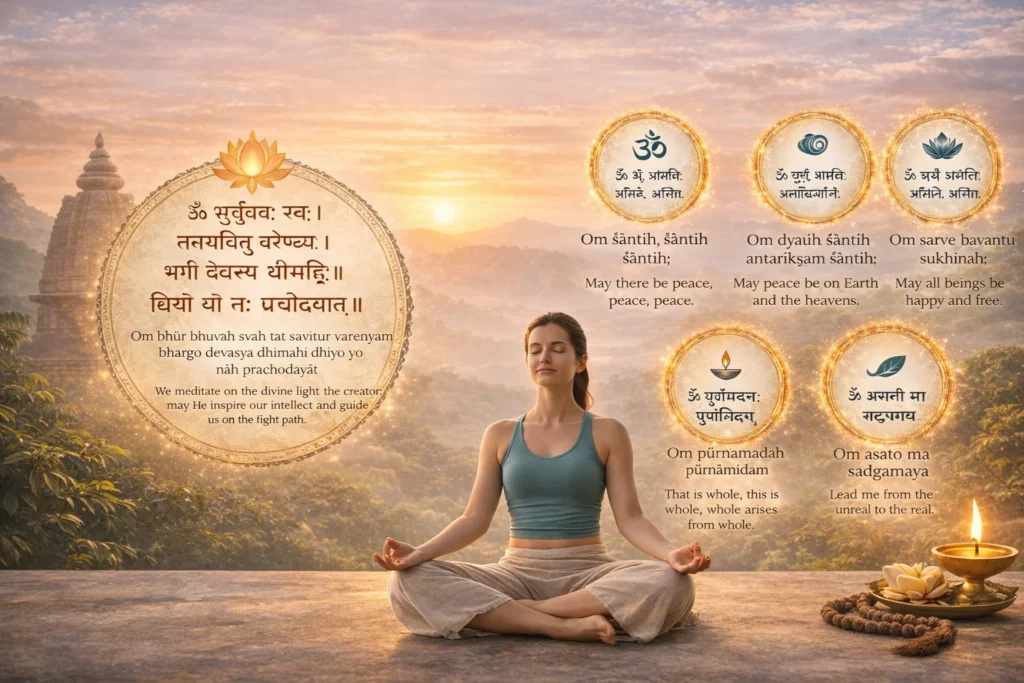
Table of Contents
- Introduction: Mantras and Their Meanings
- What are mantras? (Mantra Meaning and Examples)
- Meaning of Mantra
- Examples of Mantras
- Gayatri Mantra and Meaning | Gayatri Mantra and its Meaning
- Gayatri Mantra
- Meaning of Gayatri Mantra
- The Significance of Gayatri Mantra
- Personal Experience
- 5 Shanti Mantras and Their Meanings
- MEANING:
- Importance of Mantras
- Personal Experience: The Effects of Chanting Mantras
- Rishikesh Yog Kendra—Yoga School in Rishikesh
- Conclusion
- FAQs
Introduction: Mantras and Their Meanings
Mantras have held special significance in ancient Indian tradition. For thousands of years, people have chanted mantras as a form of meditation, prayer, and spiritual practice. In fact, mantras are not merely religious words; they are a profound combination of sound and meaning.
The sounds of the Sanskrit language are considered particularly powerful. When a person regularly chants mantras, they not only speak words but also generate a specific vibration. This is why understanding Sanskrit mantras and their meanings is considered as important as their pronunciation.
Furthermore, mantras are not solely intended to provide a spiritual experience. Many people also practice mantras for meditation, mental peace, and concentration. For example, the Gayatri Mantra and various Shanti Mantras are often used in meditation and prayer.
In this article, we will understand:
- What are mantras?
- Gayatri mantra and meaning
- 5 Shanti mantras and their meanings
- The importance and use of mantras
What are mantras? (Mantra Meaning and Examples)
Meaning of Mantra
The word “mantra” in Sanskrit is made up of two parts: “man” and “tra.”
“Man” refers to our mind or thoughts.
“Tra” is associated with protection, means, or liberation.
Thus, the general meaning of “mantra” is a sound, word, or sentence that helps stabilize the mind and give it a positive direction. Although many people view mantras as merely religious texts, their purpose is much deeper than that. When chanted repeatedly and attentively, its sound and rhythm can help calm the mind. Additionally, regular chanting helps one focus on the present moment.
In addition, mantras are also used for meditation, prayer, and mental balance. Many people chant mantras for a few minutes at the beginning or end of their day to calm and positively energize their mind. So understanding mantra meaning and examples is not just about knowing the meaning of the words but also about understanding how these sounds can affect our mental and emotional experience.
Examples of Mantras
India’s spiritual tradition contains many well-known mantras, chanted for various purposes. These mantras are not limited to religious rituals but are also used for meditation, self-reflection, and mental balance.
India’s spiritual tradition has many well-known mantras. For example:
- Gayatri Mantra
- Om Mantra
- Shanti Mantra
In addition, many people chant short mantras in their daily lives, such as “Om Namah Shivaya” or “Om Shanti.”Regular chanting of these mantras can bring a sense of peace to the mind. Over time, one starts to understand how the sound and cadence of mantras can foster a tranquil and uplifting mental space.
Gayatri Mantra and Meaning | Gayatri Mantra and its Meaning
Gayatri Mantra
ॐ भूर् भुवः स्वः
तत्सवितुर्वरेण्यं
भर्गो देवस्य धीमहि
धियो यो नः प्रचोदयात्।
Meaning of Gayatri Mantra
The Gayatri Mantra’s meaning can be grasped as follows:
We meditate on the supreme divine light, the origin of the entire universe.
We recall the pure and supreme energy that provides direction for our lives, and We hope that divine energy will guide our intellect and lead us along the right path.
Moreover, the Gayatri Mantra is considered a symbol of wisdom, awareness, and enlightenment too. Therefore, if we recite the Gayatri Mantra with concentration and real intent, it may assist us in the development of better and positive cognitive processes.
Many people have opined that the regular recitation of the Gayatri Mantra will bring a sense of calmness in our minds; therefore, it leads to better concentration. Consequently, this is the reason why the Gayatri Mantra is considered a significant part of meditation.
The Significance of Gayatri Mantra
First and foremost, the Gayatri Mantra is considered a symbol of wisdom, enlightenment, and awareness. The Gayatri Mantra is a reminder of the significance of wisdom and awareness in dealing with the complexities of our lives. Therefore, it is considered by many as a means of spiritual advancement, rather than a religious practice.
Furthermore, regularly chanting the Gayatri Mantra gradually calms and stabilizes the mind. If one recites this mantra with concentration, the thoughts may become clear, and the number of positive thoughts may increase.
This mantra is also considered effective for meditation. This mantra may be chanted in the morning or evening to begin the day with a peaceful and balanced mind. Hence, the Gayatri Mantra holds a position of great importance in the Indian tradition.
Personal Experience
In my case, I have observed that chanting the Gayatri Mantra calms the mind gradually. At first glance, it may appear to be simply chanting the mantra. However, after chanting the mantra for a period of time, the effect may be felt.
After chanting the mantra for a while, the disturbance in the mind seems to die down. Chanting this mantra, especially in the quiet atmosphere of the morning, makes it easier to concentrate.
Furthermore, sometimes chanting the Gayatri Mantra for a few minutes after a busy day can also help to lighten the mind. Gradually, this practice becomes not just a ritual but a small but meaningful part of mental peace and self-reflection.
5 Shanti Mantras and Their Meanings
Shanti mantras are commonly used to start and conclude any prayer or meditation session. The central purpose of these Shanti mantras is to cultivate tranquility within the mind, in the world around us, and in our innermost thoughts.
By repeating these mantras with concentration and devotion, one can eventually attain mental stability and balance. Regularly chanting Shanti mantras can reduce mental unrest and direct one’s thoughts in a more positive direction. For this reason, understanding and practicing the 5 Shanti mantras and their meanings is considered important in yoga, meditation, and spiritual practice.
The 5 Shanti Mantras are as follows:
- ॐ सह नाववतु
ॐ सह नाववतु
सह नौ भुनक्तु
सह वीर्यं करवावहै
तेजस्विनावधीतमस्तु
मा विद्विषावहै
ॐ शान्तिः शान्तिः शान्तिः
MEANING:
This Shanti Mantra reflects the spirit of cooperation, respect, and collective study between the Guru and the disciple. It prays that they may acquire knowledge together, strive together, and that their education be radiant and effective. It also prays that no animosity, disagreement, or negative feelings arise between them during their studies. The purpose of this mantra is to make the learning process peaceful, positive, and inspiring so that the environment for acquiring knowledge remains harmonious and balanced.
- ॐ असतो मा सद्गमय
ॐ असतो मा सद्गमय
तमसो मा ज्योतिर्गमय
मृत्योर्मा अमृतं गमय
ॐ शान्तिः शान्तिः शान्तिः
MEANING:
It is a famous prayer from the Upanishads that generates a feeling in us to move forward in life towards truth and knowledge. In this mantra, one prays to God to lead him/her from falsehood towards truth, from darkness towards light, and from mortality towards immortality. Not only is this mantra of spiritual importance, but it also conveys a message of choosing the right path in life, along with positive thinking.
- ॐ पूर्णमदः पूर्णमिदम्
ॐ पूर्णमदः पूर्णमिदम्
पूर्णात् पूर्णमुदच्यते
पूर्णस्य पूर्णमादाय
पूर्णमेवावशिष्यते
MEANING:
The Upanishads describe this mantra as a profound philosophical statement. The statement asserts that the universe and Absolute Truth are complete and that everything in the universe creators from this completeness. “When someone creates something from something complete and whole, then that something does not become incomplete.” The message given through this mantra is that there is a profound balance in life and in the universe. It also inspires us to understand that everything in creation is a part of the same complete consciousness.
- ॐ सर्वे भवन्तु सुखिनः
ॐ सर्वे भवन्तु सुखिनः
सर्वे सन्तु निरामयाः
सर्वे भद्राणि पश्यन्तु
मा कश्चिद् दुःखभाग्भवेत्
MEANING:
This Shanti Mantra expresses compassion, harmony, and universal well-being for humanity. It prays that all people be happy and healthy and experience auspicious and positive experiences in their lives. It also prays that no one should experience pain or suffering. This mantra inspires us to develop feelings of empathy, kindness, and equality toward others and conveys the message of collective well-being for the entire society.
- ॐ द्यौः शान्तिः
ॐ द्यौः शान्तिः
अन्तरिक्षं शान्तिः
पृथिवी शान्तिः
आपः शान्तिः
ओषधयः शान्तिः
MEANING:
This Shanti Mantra prays for balance and peace in all elements of nature and the universe. It prays for peace for all creation, including the sky, space, earth, water, and herbs. This mantra teaches us that our life is closely related to nature. Hence, only then can our life be peaceful and prosperous. This mantra is also related to our respect for nature and creation.
Importance of Mantras
1. Helps Concentrate the Mind
First and foremost, Sanskrit mantras help to concentrate our mind on a single point. As we regularly chant these mantras, our tendency to lose focus can gradually decrease over time.
2. Experience Mental Peace
Moreover, while we chant these Sanskrit mantras, our mind becomes peaceful and slows down. This is the reason why many people experience mental peace while or after chanting these mantras.
3. Developing Positive Thinking
The words used in these Sanskrit mantras are associated with positive thoughts. Hence, these mantras can help us bring positivity to our thoughts.
4. Facilitating Meditation Practice
Additionally, chanting mantras can be a good way to begin meditation. The meditation process will become more natural if the mind is focused on the sound of the mantra being chanted.
5. A Quiet Break in Daily Life
The chanting of mantras gives an individual a short break of quiet time in today’s fast-paced lifestyle. This short break may allow the individual to break away from the chaos of the world and clear their mind.
Personal Experience: The Effects of Chanting Mantras
The effects of chanting mantras become apparent gradually. The chanting of mantras may be considered an exercise at first. However, the mind becomes more tranquil and composed after some time.
Chanting Shanti mantras, in particular, brings a sense of positivity to the mind. When one sits quietly and chants mantras for a few minutes, the breathing rate gradually normalizes. Along with this, unnecessary thoughts in the mind begin to diminish.
Sometimes, after a busy day, chanting mantras for just a few minutes can make the mind feel lighter. Therefore, for me, it has become not only a spiritual practice but also a simple way to maintain mental balance.
Rishikesh Yog Kendra—Yoga School in Rishikesh
Rishikesh Yog Kendra is a yoga school that offers a blend of technology as practiced by modern education systems, along with the ancient wisdom of yogic philosophy, in a location that is believed to be spiritually charged. For those who are interested in upgrading their skills to become yoga teachers, Rishikesh Yog Kendra offers 100-hour YTTC in Rishikesh, 200-hour yoga teacher training, and 300-hour yoga teacher training course in Rishikesh, along with Aerial Yoga TTC .
The course offers training in asanas, pranayama, meditation, yoga philosophy, anatomy, etc., which offers a genuine foundation in the art and science of yoga. Upon completion of the course, students are awarded a Yoga Alliance Certified Course certificate that enables them to teach yoga anywhere around the globe. The entire experience is further enhanced by a comfortable stay at a place that offers sattvic food along with a visit to some of the beautiful locations of Rishikesh. The yoga school offers a perfect platform for those who are eager to learn and practice the ancient art of yoga in a spiritually charged environment.
Conclusion
The tradition of mantras goes way back in time. These are not only composed of words but are also rich in spiritual and cultural values. Hence, when a person recites the mantras, they not only recite the words but are also associated with the tradition of ancient wisdom.
It may be the Gayatri mantra and its meaning, the 5 shanti mantras and their meanings, and so on. All these mantras are a reminder of the importance of inner peace, positive thoughts, and a balanced mind. Moreover, these mantras are a way to bring peace to the mind.
In today’s busy schedule, when the mind is full of stress and anxiety, reciting a mantra for a few minutes may bring a pause. This may also help a person to become more aware of their thoughts and feelings. Hence, reciting the mantras may not only be a spiritual practice but may also bring a sense of peace and balance to the mind.
FAQs
Q1. What are mantras?
Ans. Mantras are sacred sounds or phrases used in meditation and prayer.
Q2. What is the meaning of the Gayatri Mantra?
Ans. It is a prayer for divine light to guide our intellect.
Q3. Why are Shanti mantras chanted?
Ans. They promote peace and harmony.
Q4. Can beginners chant mantras?
Ans. Yes, beginners can start with simple mantras like Om or the Gayatri Mantra.
Q5. Do mantras help with meditation?
Ans. Many practitioners find that chanting helps improve focus and calmness.