
Introduction: Advanced Yoga Poses
Ever wondered why some yoga poses look impossible yet feel effortless to experts? Advanced yoga poses challenge your strength, balance, and flexibility while helping you develop deeper body control and focus. In this guide, you’ll learn 5 advanced yoga poses step by step, along with their benefits, common mistakes, and expert tips to practice them safely.
However, advanced yoga poses are not only about the complex nature of the pose. They are also about gaining an understanding of your body and how to control your body. Furthermore, they serve to strengthen both mental focus and self-confidence.
In my own experience, these poses were quite intimidating at first. However, as I slowly got into the habit of being consistent, the improvements were the most motivating aspects of all.
What Are Advanced Yoga Poses?
Advanced yoga poses are asanas in which physical strength, balance, flexibility, and control all work in unison. For this reason, these poses are also referred to as “difficult” yoga poses.
However, these are not just poses that are difficult to achieve but are in fact meant to enhance the bond between your body and your mind.
In this regard, in my own experience, I have found that when I first started with the advanced poses in yoga, I thought it was all about the strength in the body.
Advanced Yoga Poses Chart
| S.No. | Pose Name | Focus | Level |
| 1 | Crow Pose | Balance | Intermediate |
| 2 | Headstand | Strength | Advanced |
| 3 | Scorpion Pose | Flexibility | Advanced |
| 4 | Firefly Pose | Core | Advanced |
| 5 | Eight-Angle Pose | Control | Advanced |
How to Learn Advanced Yoga Poses Safely?
Learning advanced yoga poses is always exciting, but if not done in a safe manner, it may lead to injury. Hence, it is absolutely essential to learn how to do it in a safe manner.
First and foremost, it is essential to have a strong foundation. Attempting to learn advanced yoga poses without a strong foundation may not be safe. Also, it is essential to have a gradual learning curve, and hence, it is not advisable to attempt a complex yoga pose at once.
Also, it is essential to have a proper warm-up. If possible, seek guidance from an experienced instructor. Finally, maintain consistency. The greatest secret to safe learning is regular practice combined with patience.
5 Advanced Yoga Poses (Steps, Benefits & Common Mistakes)
1. Bakasana (Crow Pose)
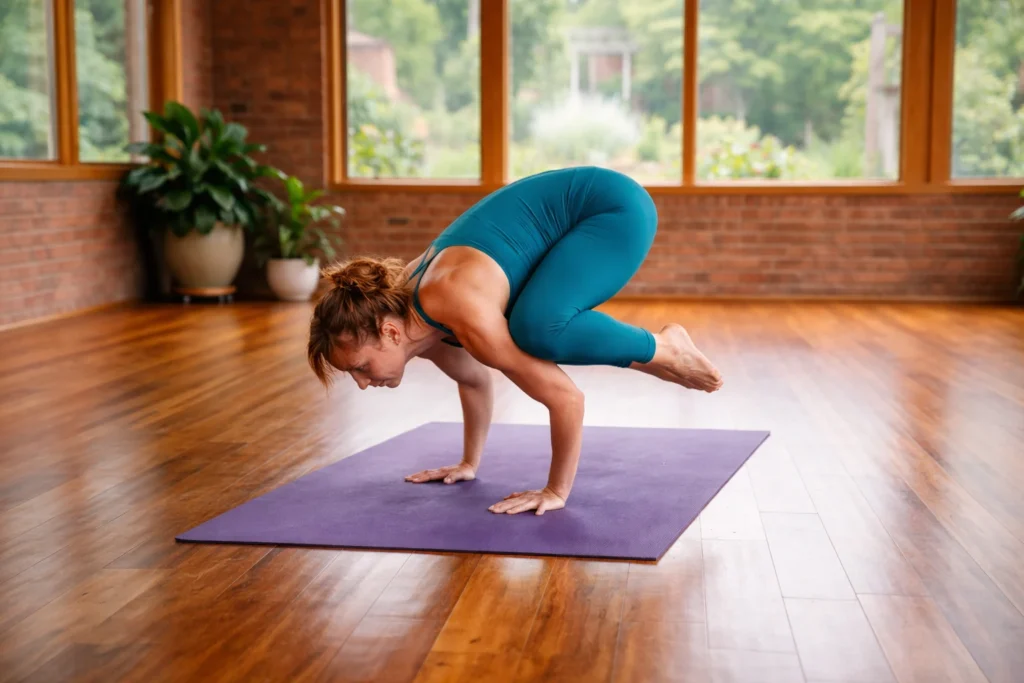
How to Perform
- To get into Bakasana, begin by squatting down.
- Press your palms down into the ground.
- Then, bring your knees up onto the tops of your elbows.
- Lean forward, and your feet should leave the ground.
- Always look forward and balance your body.
Benefits
- Increases the strength of the arms and shoulders.
- Helps improve balance and coordination.
- Strengthens focus and concentration.
Common Mistakes
- Looking downward, which disrupts balance.
- Attempting to lift the feet too quickly.
- Failing to engage the core muscles.
2. Shirshasana (Headstand)
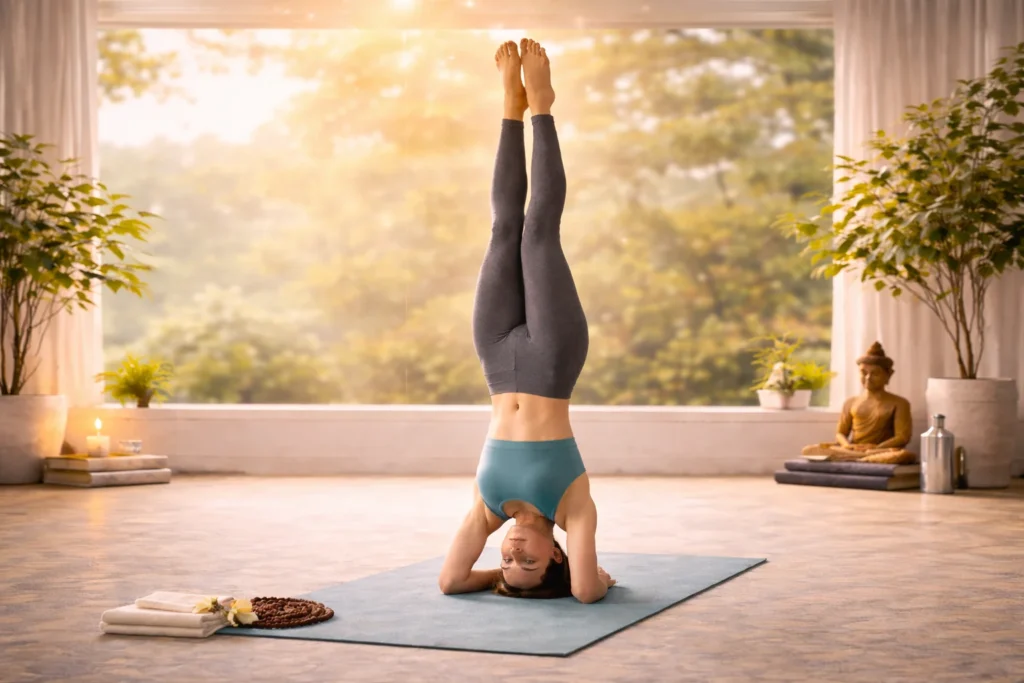
Steps
- Place your forearms on the ground.
- Gently place your head down.
- Use your hands to place your head down.
- Slowly lift your legs upwards.
- Maintain your body in a straight line.
Benefits
- Improves blood circulation.
- Improves mental clarity.
- Strengthens your upper body muscles.
Mistakes
- Attempting to go straight into the pose without proper preparation.
- Placing excessive pressure on the neck.
- Panicking if you lose your balance.
3. Vrischikasana (Scorpion Pose)
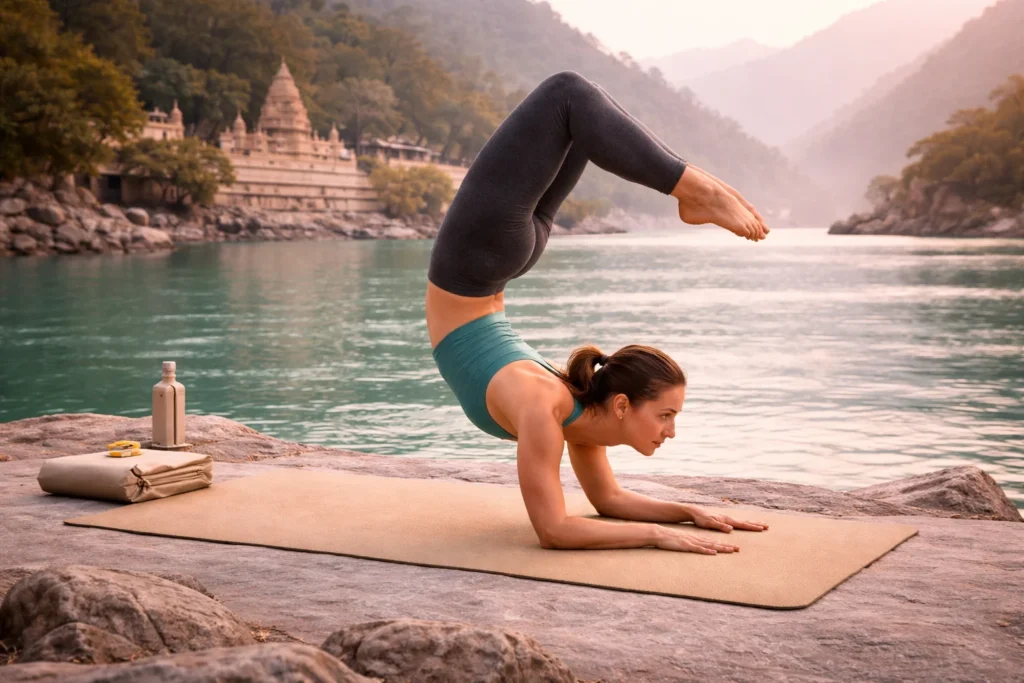
Steps
- To assume the forearm stand position.
- Lift your legs upward.
- Slowly bend your knees and arch your back backward.
- Maintain your balance while executing the backbend.
Benefits
- Increases spinal flexibility.
- Strengthens the shoulders and arms.
- Improves body control.
Mistakes
- Attempting the pose without sufficient back flexibility.
- Trying to execute the backbend too quickly.
- Holding your breath.
4. Tittibhasana (Firefly Pose)
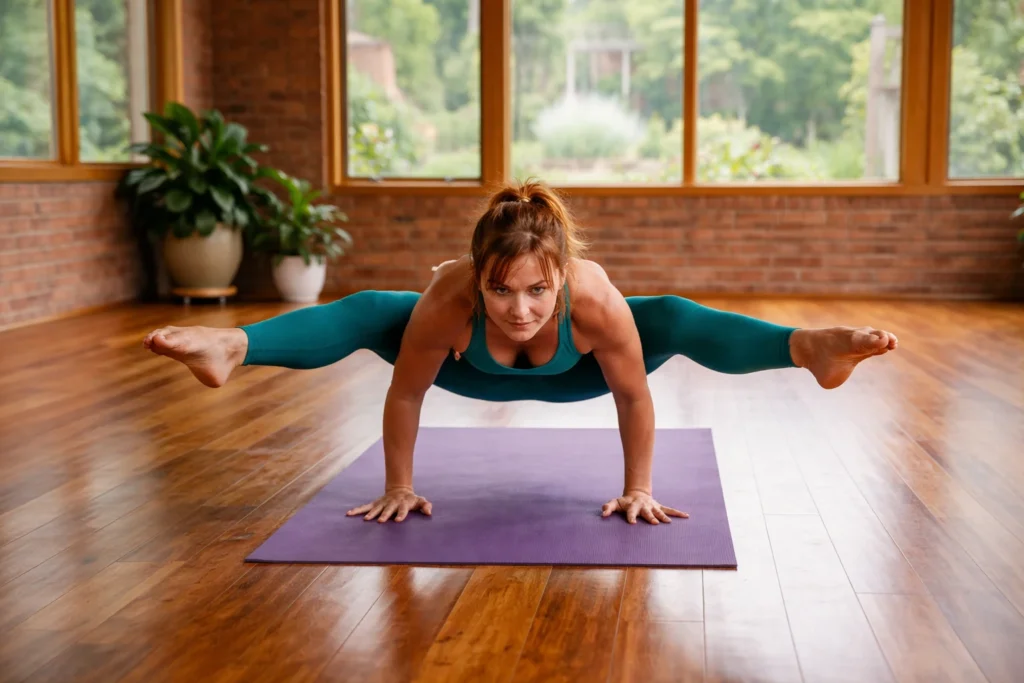
Steps
- Squat down and put your legs over your shoulders.
- Put your hands firmly on the ground.
- Slowly raise yourself up from the ground.
- Straighten your legs.
Benefits
- Increases core strength.
- Strengthens the arms and wrists.
- Improves overall flexibility.
Mistakes
- Attempting to straighten the legs too quickly.
- Failing to focus on maintaining balance.
- Skipping the warm-up phase.
5. Astavakrasana (Eight-Angle Pose)
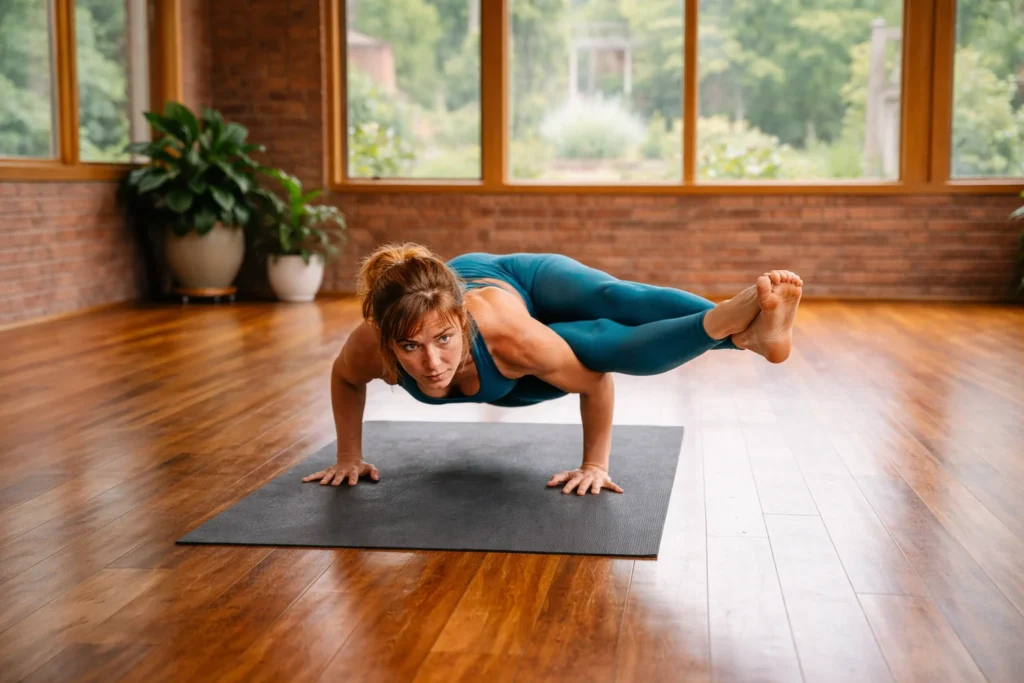
Steps
- Place one leg over your shoulder.
- Place your hands firmly on the ground.
- Lift your body
- Cross your legs to maintain balance
Benefits
- Builds full-body strength
- Improves coordination
- Enhances focus and stability
Common Mistakes
- Trying to hurry through this pose
- Not putting weight on your hands
- Not keeping your body under control
How to Learn Advanced Yoga Poses (Step-by-Step Approach) For Beginners
Master the Basics First
It is very important to master the basics of various yoga poses such as the plank pose, dog pose, and balancing pose because these are the foundation of advanced yoga poses.
Stay Consistent
Practicing a little bit every day is far more effective, as consistency allows the body to gradually adapt and make steady progress over time.
Avoid Rushing
Attempting to learn too quickly increases the risk of injury; therefore, taking your time to learn each pose gradually is a safer and more effective approach.
Practice Regularly
Practicing at least 4 to 5 days a week will help you develop flexibility as well as strength in the body, which will help you to perform advanced poses more easily.
Perform a Proper Warm-Up
It is very important to perform a proper warm-up for each session. A proper warm-up helps in ensuring that the muscles are ready for the session, thus reducing the possibilities of strain or injury.
Listen to Your Body
In case you feel some form of discomfort or pain in a pose, you should stop right away, as failure to do so may result in harm to your body.
Seek Guidance When Needed
In the beginning stages, it is always easy to seek guidance from a qualified instructor or reliable sources to assist you in learning the correct technique and avoiding common mistakes.
Focus on Breathing
Proper breathing is important to assist you in attaining a proper balance and stability in your pose while keeping your body in a relaxed state.
Break Down the Pose
It is important to learn any difficult yoga pose by breaking it down into smaller parts, and this helps in boosting one’s confidence as well.
Be Patient with Progress
Everyone’s body is unique; therefore, avoid comparing your progress to others and embrace your own gradual improvement at your own pace.
Personal Experience
To begin with, I attempted to acquire advanced yoga poses at a faster rate than what was required. I believed that the more I invested, the faster the results would come, but this was not the case. Once, I tried to perform a headstand without proper warming up, but I lost balance while doing so. On that day, I realized that the rate at which the practice of yoga is done is of no consequence, but the level of awareness is what matters.
After that, I made a change in the practice of yoga by sticking to the basics and moving at a slower rate while at the same time listening to my body. Some weeks after, I noticed that the poses were more stable and comfortable than before. Even today, I firmly believe that the best way to master advanced yoga poses is through a slow, steady, and mindful practice.
Rishikesh Yog Kendra-Yoga School in Rishikesh
Practicing yoga in the calm and embracing environment of the mountains, where the rhythm of life is slightly different, is an experience in itself. Rishikesh Yog Kendra, situated in the beautiful city of Rishikesh, offers the opportunity to experience this through their range of yoga teacher training courses. We provide a 100-hour YTTC in Rishikesh, a 200-hour yoga TTC, and a 300-hour yoga teacher training course along with short courses such as Aerial YTTC and Sound Healing YTTC in Rishikesh.
Daily routines combine physical practice, breathwork, and self-reflection, encouraging a more profound internal connection. Simple accommodations and wholesome meals further cultivate a sense of balance and focus. In the end, it is not just a certificate that you collect; it is a perspective that you get to take with you and spread in the world.
Conclusion
Advanced yoga poses appear just as challenging as they are rewarding. However, mastering them requires not only physical strength but also patience, consistency, and the right approach. Therefore, if you truly wish to make progress, always begin with the basics and advance gradually.
Furthermore, understanding your body and respecting its limits is absolutely essential; for in yoga, performing a pose correctly is far more important than rushing through it. Over time, you will notice that your balance, flexibility, and confidence all begin to improve.
Ultimately, advanced yoga poses are not a destination but a journey. Therefore, cherish every small improvement and approach your practice as an experience rather than a source of pressure. It is this very mindset that will guide you toward safe and sustainable progress.
FAQs
Q1. What are advanced yoga poses?
Ans. These are poses that simultaneously demand strength, flexibility, and balance.
Q2. What is the most advanced yoga pose?
Ans. The Scorpion Pose and the Handstand are considered the most difficult.
Q3. How can one learn advanced yoga poses?
Ans. They can be learned gradually through regular practice and proper technique.
Q4. Are advanced yoga poses for women different?
Ans. No, the poses are the same—the only difference lies in strength and flexibility.
Q5. Can beginners attempt advanced yoga poses?
Ans. Beginners should first learn the basic poses.