Español









Introduction to Aerial Yoga
Course Highlights
50 Hrs Aerial YTTC Fee
7 DaysLearning to teach Aerial Yoga well begins with understanding yoga itself. The 50 Hour Aerial Yoga Teacher Training in Rishikesh at Rishikesh Yog Kendra is a focused, residential course that teaches aerial practice on a foundation of traditional yoga, with real attention to alignment, breath, anatomy and safety.
Aerial Yoga, sometimes called air yoga, uses a soft fabric hammock to support part or all of your body weight. That support lets the spine lengthen, makes inversions more accessible, and helps a student feel a movement that can be difficult to find on the mat alone. It is one reason aerial yoga classes have grown so popular in studios around the world.
Our approach is what sets this course apart. In many programmes the hammock is used mainly for tricks. Here it is a teaching tool, not the whole practice. What matters is knowing why a movement is safe, how the breath supports it, and how to guide another person into it with care. This is the point where traditional yoga and modern aerial work come together.
The course suits professionals who already teach, such as yoga teachers, Pilates and fitness instructors, dancers and studio owners, as well as dedicated practitioners and beginners who want to specialise from the start. Over 50 hours across seven residential days, you practise daily in small groups, with personal, hands-on guidance, and safety treated as a first principle throughout.
You also learn the craft of teaching: safe movement, alignment, breath awareness, anatomy and a clear teaching methodology, including real practice leading a class yourself. Studying in Rishikesh, a long-standing centre of yoga, places this training within the tradition it grows from and gives you time to absorb it properly, rather than in a single weekend at home.
The 50 Hour Aerial Yoga Teacher Training at Rishikesh Yog Kendra is a seven-day residential course in Rishikesh, India, that trains you to teach Aerial Yoga safely and confidently. It combines daily hammock practice with alignment, breath awareness, anatomy and teaching methodology, all built on a foundation of traditional yoga. The course welcomes beginners as well as experienced practitioners and teachers.
Aerial Yoga is a form of yoga practised with the support of a soft fabric hammock suspended from a fixed point. In a traditional mat practice, the floor is your only support and gravity works in a single direction. The hammock changes that relationship. It can take some of your body weight, which allows the spine to decompress, supports the body in inversions, and helps you feel an alignment that is harder to reach on the mat. The effect is a practice that is gentler on the joints in some postures and more demanding on stability and control in others. What does not change are the principles of traditional yoga: the breath, the alignment and the awareness are all still central, simply applied in a new way.
The course runs for 50 hours over seven days and is fully residential. Living on campus for the week means you practise every day in a steady rhythm, with your teachers close at hand and the essentials of daily life taken care of, so your attention stays on the training. Instruction is given in English and Hindi, which keeps the course accessible to international students.
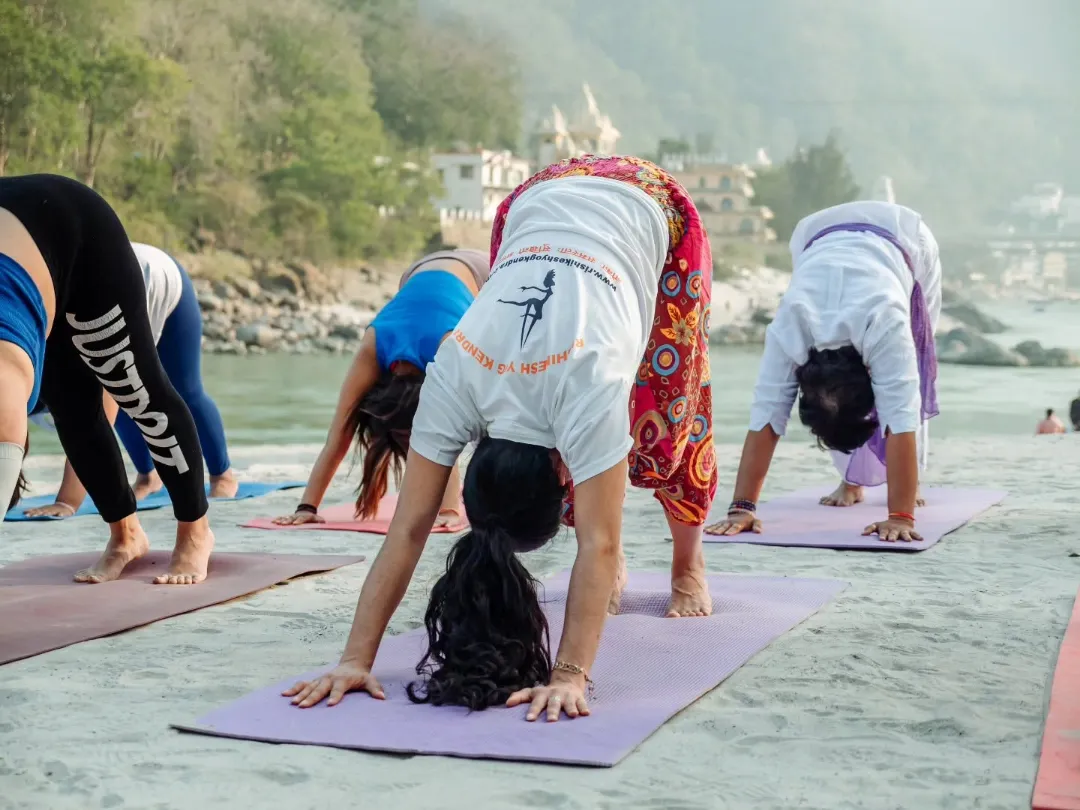
The training is deliberately hands-on. Most of each day is spent practising with the Aerial Yoga Hammock: learning how to enter and leave postures safely, how to move between them, and how to work within your own range. Setting up and checking the hammock, understanding where and how the body makes contact with it, and recognising common mistakes are all practised until they become familiar. This daily, practical work is what builds genuine competence, rather than a theoretical acquaintance with poses.
What the 50 hours include:
Because this is a teacher training and not only a personal practice, a clear part of the course is given to how to teach. You learn to structure and sequence an aerial class, to give clear and safe instructions, to demonstrate well, and to adjust a student in the hammock. You also practise teaching your peers, so that you finish the week having actually led a class rather than only having taken one.
The 50 Hour Aerial Yoga Teacher Training suits a broad range of students. Yoga teachers, Pilates and fitness instructors, personal trainers, dance instructors, studio owners and other wellness professionals often take it to add aerial work to what they already offer. Dedicated practitioners join to broaden their own practice. Complete beginners are welcome too, as the course starts with the fundamentals and builds from there.
By the end of the week, you have a solid, practical understanding of Aerial Yoga and the confidence to teach it responsibly. You leave able to plan and lead a safe, well-structured class, to guide students of different levels, and to bring the care and precision of traditional yoga to a modern aerial practice. Many students also find that this Aerial Yoga Training refreshes their own practice and gives them a new way to keep growing as a teacher.
The 50 Hour Aerial Yoga Teacher Training is designed for complete beginners as well as experienced movement and wellness professionals. It suits yoga teachers, Pilates and fitness instructors, personal trainers, dancers and wellness practitioners who want to add aerial work to their teaching, along with dedicated practitioners and newcomers who want to specialise in Aerial Yoga. No prior aerial experience is required.
A short, focused course still asks something of you, so it is worth being honest about who it fits before you book. Aerial Yoga sits naturally alongside many kinds of movement practice, which is why students arrive from very different backgrounds and still learn well together.
What matters most is not a particular level of strength or flexibility, but a willingness to practise carefully and to take safety seriously. The hammock rewards attention and control far more than force.
This course is likely a good fit if you recognise yourself in any of these:
You are new to Aerial Yoga, and perhaps to teaching, and you want to learn it properly from the start. The course begins with the fundamentals, so no previous aerial experience is needed.
You already teach mat-based yoga and want to add a well-founded aerial practice to your classes, taught in a way that respects the principles you work from.
Your grounding in core strength, control and precise movement transfers directly to aerial work, and the hammock gives you a new tool for your students.
As a personal trainer or fitness coach, you want a fresh, safe and popular offering that builds on your understanding of the body and movement.
You work in bodywork, therapy or another wellness field, and you want to bring the decompression, breath and gentle movement of Aerial Yoga into what you do.
Your sense of body awareness, line and expression suits aerial movement well, and the hammock offers a new medium to explore.
Whatever your background, you would like to broaden what you can offer and grow in confidence as a teacher.
The course welcomes a wide range of ages and fitness levels, and it is taught in English and Hindi, so international students can follow every session. Because groups are small, mixed-background classes work well: beginners are supported step by step, and those with more experience are given room to refine and go further.
It is worth being clear about what the week involves. This is a residential, hands-on course with daily practice, and aerial work does ask for a degree of physical engagement and steady attention. You do not need to arrive strong or flexible, but you do need to arrive ready to practise, to follow safety guidance closely, and to learn actively rather than watch. Students who come with that attitude tend to progress quickly.
If that sounds like you, the 50 Hour Aerial Yoga Teacher Training in Rishikesh is very likely a strong fit, whether you are stepping into aerial work for the first time or adding it to years of teaching experience.
Choosing the right yoga teacher training is an important decision. Speak with our Course Advisor to discuss the curriculum, daily schedule, accommodation, fees, and everything you need to know before joining. We're here to make your journey simple and stress-free.
Connect on WhatsApp Chat with our course advisorGet a reply within 15 minutes during working hours
Rishikesh Yog Kendra teaches Aerial Yoga on a foundation of traditional yoga, in small groups, with daily hands-on hammock practice and individual guidance from experienced teachers. Safety, proper alignment and real teaching practice are central to the course, and the residential setting in Rishikesh gives students the time and focus to learn the practice thoroughly.
Aerial Yoga courses are offered almost everywhere now, so it is fair to ask what makes one worth travelling for. In our case, the answer has less to do with the hammock itself and more to do with how the course is taught and what you carry away from it. Here is what stands behind our 50 Hour Aerial Yoga Teacher Training in Rishikesh.
Aerial work at our school is grounded in the principles of traditional yoga: breath, alignment and awareness come first, and the hammock is used to serve them. This foundation is what allows you to teach with understanding rather than to copy a routine.
Groups are kept small, which keeps the training practical and personal. In a small group your teachers can see how you move, correct you directly, and adapt their guidance to how you learn, which is difficult in a crowded class.
You practise with the Aerial Yoga Hammock every day. This steady, repeated practice is how safe technique becomes second nature, and it achieves far more than the occasional session a weekend course allows.
Our instructors have spent years in their own practice and in the classroom. They take time to explain the reasoning behind each movement and to answer your questions, so you finish the course genuinely understanding what you teach.
Safety is treated as a first principle, not a disclaimer. You learn how to set up and check the hammock, how to work within your own range, and how to keep a future student safe, and these habits are built into every session.
Staying on campus for the week keeps you close to the practice from morning to evening, with the distractions of daily life set aside. Rishikesh has been a centre of yoga study for generations, which gives the training a depth that a studio far from that tradition cannot easily match.
Students come to Rishikesh Yog Kendra from many countries, and learning alongside people from different backgrounds is part of the experience. It broadens how you think about teaching and often leads to lasting connections.
Because this is a teacher training, you spend real time teaching. Guided practice sessions let you lead your peers, receive feedback, and build the confidence to stand in front of a class of your own once the course is over.
Choosing a course is, in the end, a question of what you want to leave with. We would rather you finish able to teach Aerial Yoga safely and well than simply able to perform in a hammock, and that intention shapes every part of the training.
In a 50 Hour Aerial Yoga Teacher Training you learn how to practise and teach Aerial Yoga safely: how to set up and use the hammock, aerial postures and inversions, alignment and safe movement, breath awareness, the relevant anatomy, and teaching methodology. The course is built on traditional yoga foundations and includes supervised teaching practice.
The 50 hours are structured so that each part of the training supports the next. You begin with the foundations that keep the practice safe, build a working repertoire of aerial postures, and then learn how to sequence and teach them. Practice and understanding are developed together, because a good aerial teacher needs both the physical skill and the reasoning behind it. The areas below make up the core of what you study.
Every part of the training rests on a safe setup, so this is where the course begins. You learn how the Aerial Yoga Hammock works, how to check and adjust it correctly, and how to judge a safe working height and space. You also learn the basic points of contact between the body and the fabric, how to enter and leave the hammock with control, and the safety principles that apply to every posture that follows. A clear grasp of these fundamentals is what allows everything else to be practised with confidence.
With the foundations in place, you build a working repertoire of aerial postures. You practise supported standing and seated shapes, gentle backbends, and the inversions that Aerial Yoga is well known for, where the hammock holds the body safely upside down. Just as important as the postures themselves are the transitions between them: how to move smoothly and safely from one shape to the next, which is the difference between a flowing class and a disconnected set of tricks.
Good alignment protects both you and your future students, and it is emphasised throughout. You learn how the body should be positioned in each posture, how the hammock changes the usual alignment cues, and how to recognise and correct common mistakes. The principles of safe movement, such as working within a sensible range, engaging the right muscles, and avoiding strain on the joints and spine, are applied to every practice.
Aerial Yoga is still yoga, and the breath remains central to it. You learn to coordinate breath with movement, to use the breath to steady and support the body in demanding shapes, and to bring the calm awareness of traditional practice into aerial work. This grounding in traditional yoga is what keeps the practice meaningful rather than purely physical.
A teacher needs to understand the body well enough to keep students safe. This part of the course covers the anatomy most relevant to aerial work: the spine, shoulders, hips and core, how they move and bear load, and the places where care is needed. You learn how the support of the hammock affects the body, and how to adapt a practice for different bodies and limitations.
Woven through the week alongside the daily hammock practice.
This is where you learn to teach rather than only to practise. You study how to structure and sequence an aerial class, how to give clear and safe instructions, how to demonstrate well, and how to adjust a student in the hammock. You also learn to observe a class as it moves, to manage pace and timing, and to keep a group safe throughout.
Finally, you put it all together. Guided teaching sessions give you the chance to lead your peers, apply what you have learned, and receive honest feedback. By the end of the course you have taught, not just trained, which is what builds the confidence to lead a class of your own.
The course opens on the ground, not in the air. Before anything else you learn what the hammock is, how it is rigged and checked, and how a body behaves once it is partly supported by fabric rather than the floor.
The core of the course. You work through the aerial postures from the ground up, starting with the ones that keep both feet down and building toward fuller suspension as the week goes on. No aerial experience is assumed.
Going upside down is what draws most people to aerial, and it is also where the risk sits. This module treats inversion as a skill to be built rather than a trick to be attempted.
Aerial work loads the body in ways a mat practice does not, so the anatomy here is specific rather than general. The emphasis throughout is on what a teacher needs in order to keep a room safe.
A short module, and arguably the most important one on the course. It is what separates a teacher who can lead an aerial class from a practitioner who can perform in one.
Rather than handing you a fixed routine to repeat, this module teaches you to build your own — which is what makes the certificate worth something once you are home and teaching your own students.
You teach during the course, not only afterwards. Practical teaching experience is built into the week so that the certificate reflects something you have actually done.
The day opens with meditation and includes pranayama alongside the aerial work, so the course stays a yoga training rather than a movement workshop.
A gentle rhythm — from first breath at dawn to stillness at night.
* Schedule may vary slightly depending on the programme and season
Yes. On successful completion of the 50 Hour Aerial Yoga Teacher Training, you receive a Certificate of Completion from Rishikesh Yog Kendra. Certification is based on full participation throughout the course together with a practical assessment of your aerial practice and your teaching, so the certificate reflects genuine competence rather than attendance alone.
Certification on this course is straightforward, and it is designed to reflect what you can actually do by the end of the week rather than what you have simply sat through.
When you finish the course and meet its requirements, you receive a Certificate of Completion from Rishikesh Yog Kendra confirming that you have completed the 50 Hour Aerial Yoga Teacher Training. The certificate recognises both your personal practice and your readiness to teach Aerial Yoga safely.
Assessment is continuous rather than a single final exam. Your teachers follow your progress across the week, in daily practice and in the way you apply what you learn. Consistent attendance and active participation matter, because aerial skill is built through steady, hands-on work. This ongoing observation also means feedback reaches you while there is still time to act on it, not only at the very end.
The heart of certification is practical. Toward the end of the course, you demonstrate your own aerial practice and lead a short teaching session for your peers. Your alignment, safety awareness, clarity of instruction and ability to guide others are all taken into account. This practical evaluation is what confirms you are ready to teach, since leading a class well, rather than memorising a routine, is the real aim of the training.
Once these requirements are met, your certificate is issued. More than a formality, it is a sign that you can take the practice into a class of your own with care and confidence.
Every batch begins on the 25th of the month and runs seven days. Tuition, accommodation and three sattvic meals a day are included. Places are limited, and the popular months tend to fill early.
Secure Booking • Best Price Guarantee • Limited Spots
Here is exactly what the fee for the 50 Hour Aerial Yoga Teacher Training covers, and what it does not. The course is residential, so your stay, your meals and every hammock and prop you need are already included — and we would rather be plain about the few things that sit outside it than leave you to find out later.
Everything covered inside your program fee
Good to know before you book
We strongly believe that a student needs practical exposure apart from book knowledge to have a great career. For the same reason, we organise weekly excursions to various holy sites as well as picturesque sites in Rishikesh. The excursions are an important part of the curriculum. You can avail yourself of the opportunities to practice yoga and meditation in some of the serene and tranquil spots in the region.
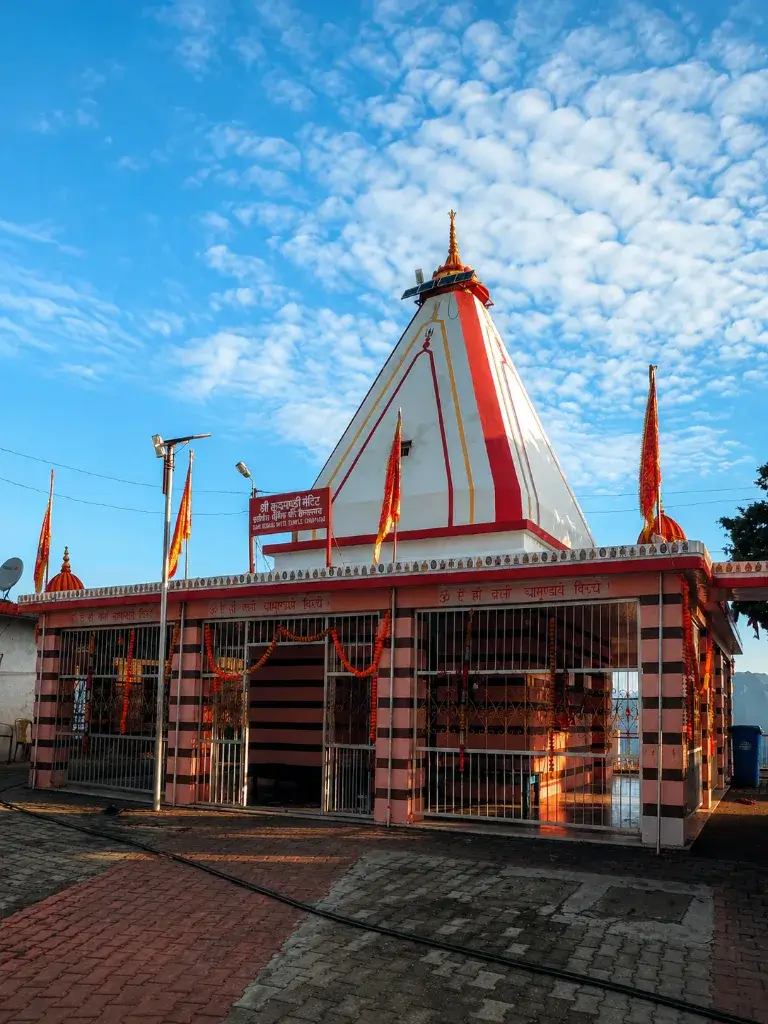
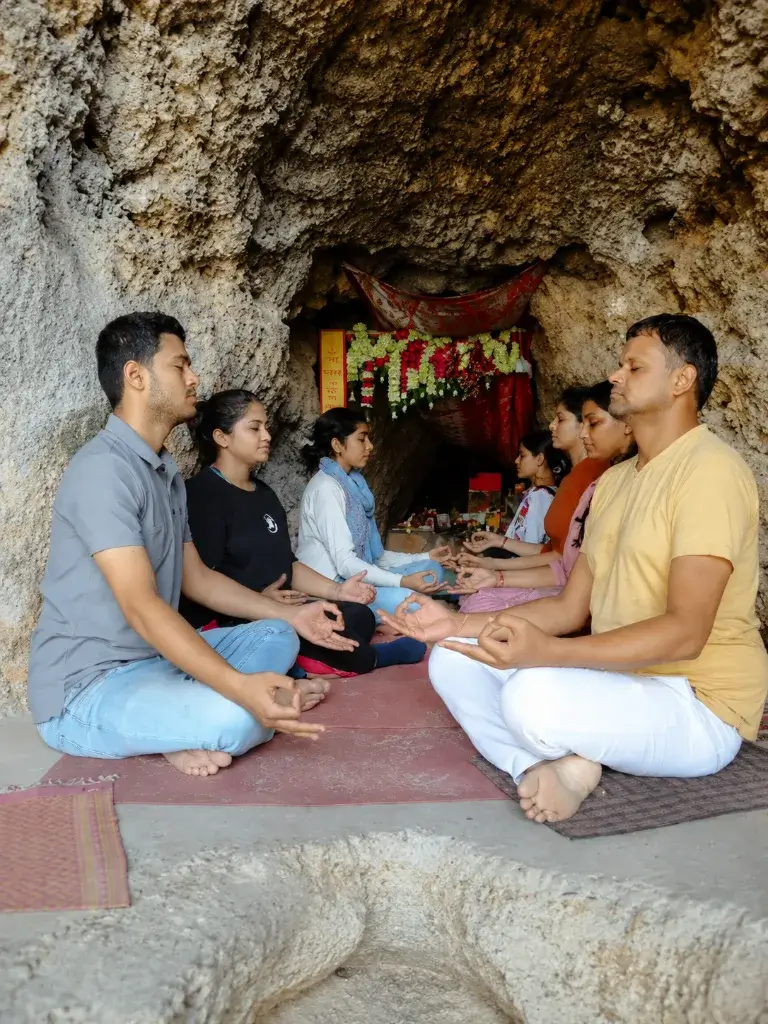
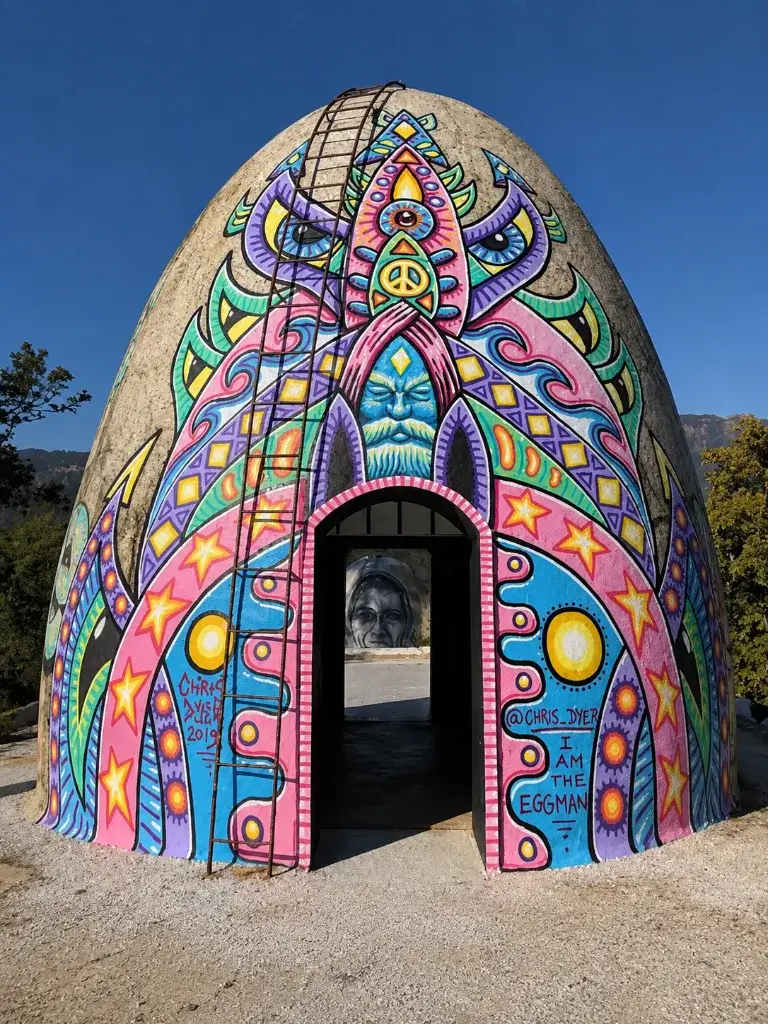
Rishikesh has some famous spots, like Kunjapuri Temple, Ganga beach, Rishi Vasishta’s Cave, and the Beatles Ashram. Many tourists also throng the region for various pursuits. You can experience the heights of spirituality at such places. Moreover, you can establish a stronger connection with nature. So, it is important for you to go on such excursions as part of your training in Rishikesh.
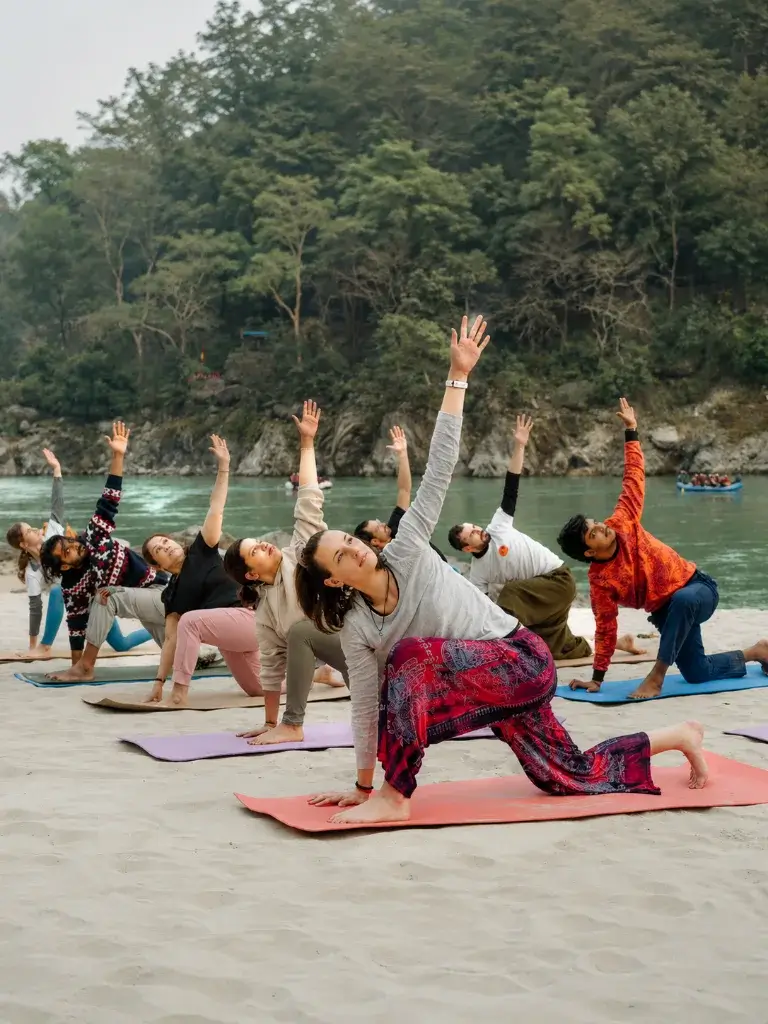
Life here is as much a part of the training as the classes themselves. Days begin early with practice, meals are simple and satvik, and there is quiet time to study, rest or walk down to the Ganga. Students arrive from all over the world and rarely leave as strangers. See it for yourself below.
In aerial more than anywhere else, you learn only as well as the person watching you — upside down, you cannot see your own alignment, so someone else has to. Our instructors are certified teachers with years in the fabric as well as on the mat, and Vimlesh Joshi Ji, who founded the school, teaches the aerial work himself alongside Hatha and Ashtanga. They explain the reasoning behind each practice, correct you personally, and make room for questions, so you leave able to teach rather than only to perform. Meet the team below.
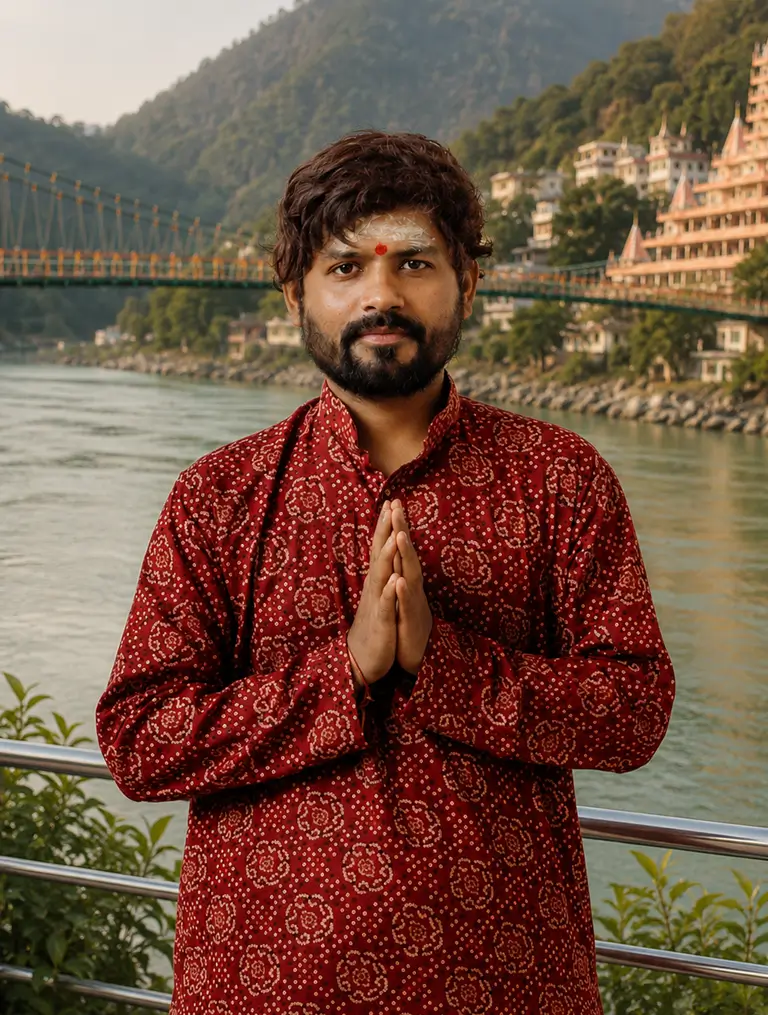
Founder · Hatha, Aerial & Ashtanga
Founder of Rishikesh Yog Kendra, Vimlesh Ji has spent more than a decade teaching Hatha, Aerial and Ashtanga yoga in the Himalayan tradition.
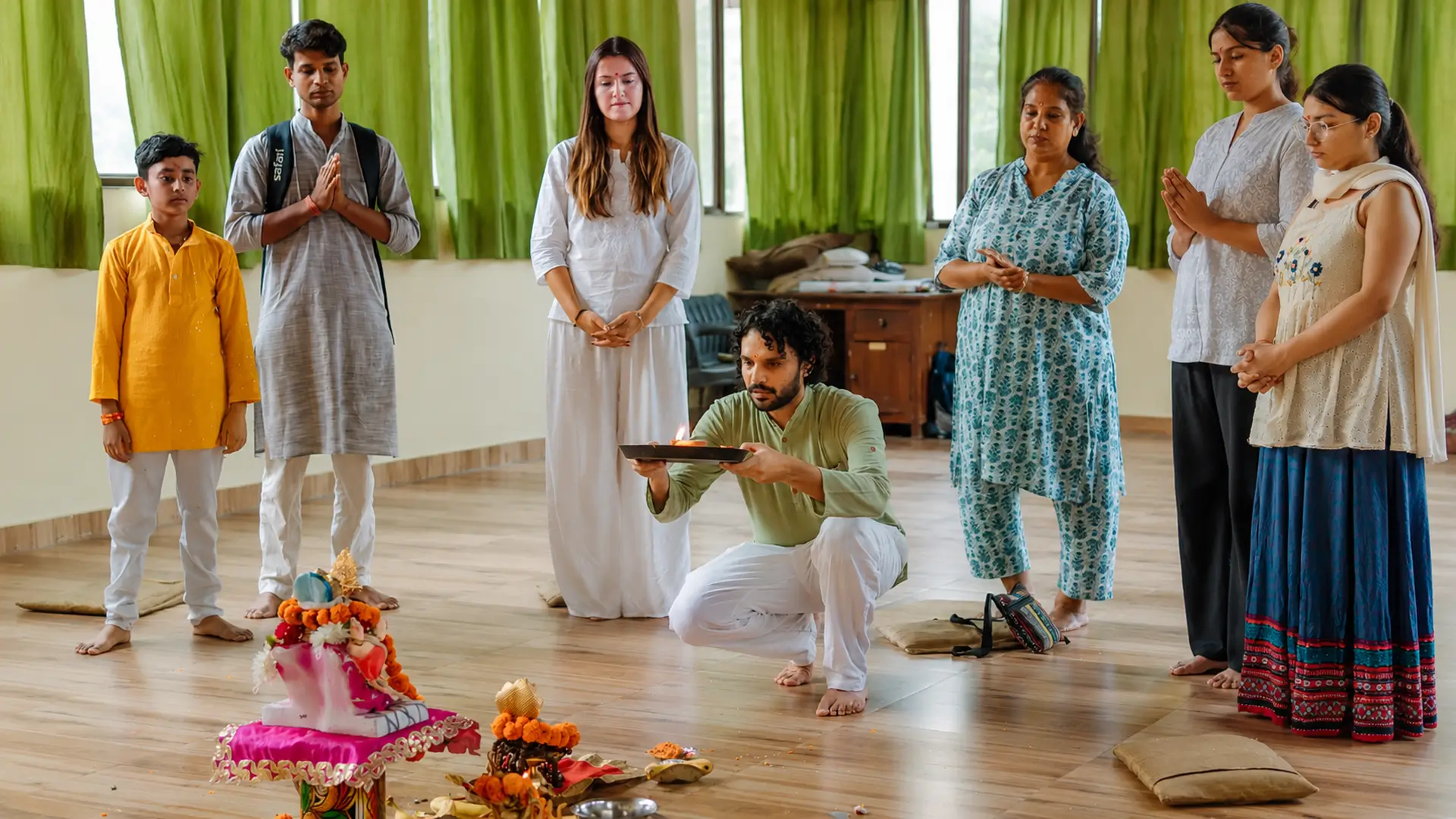
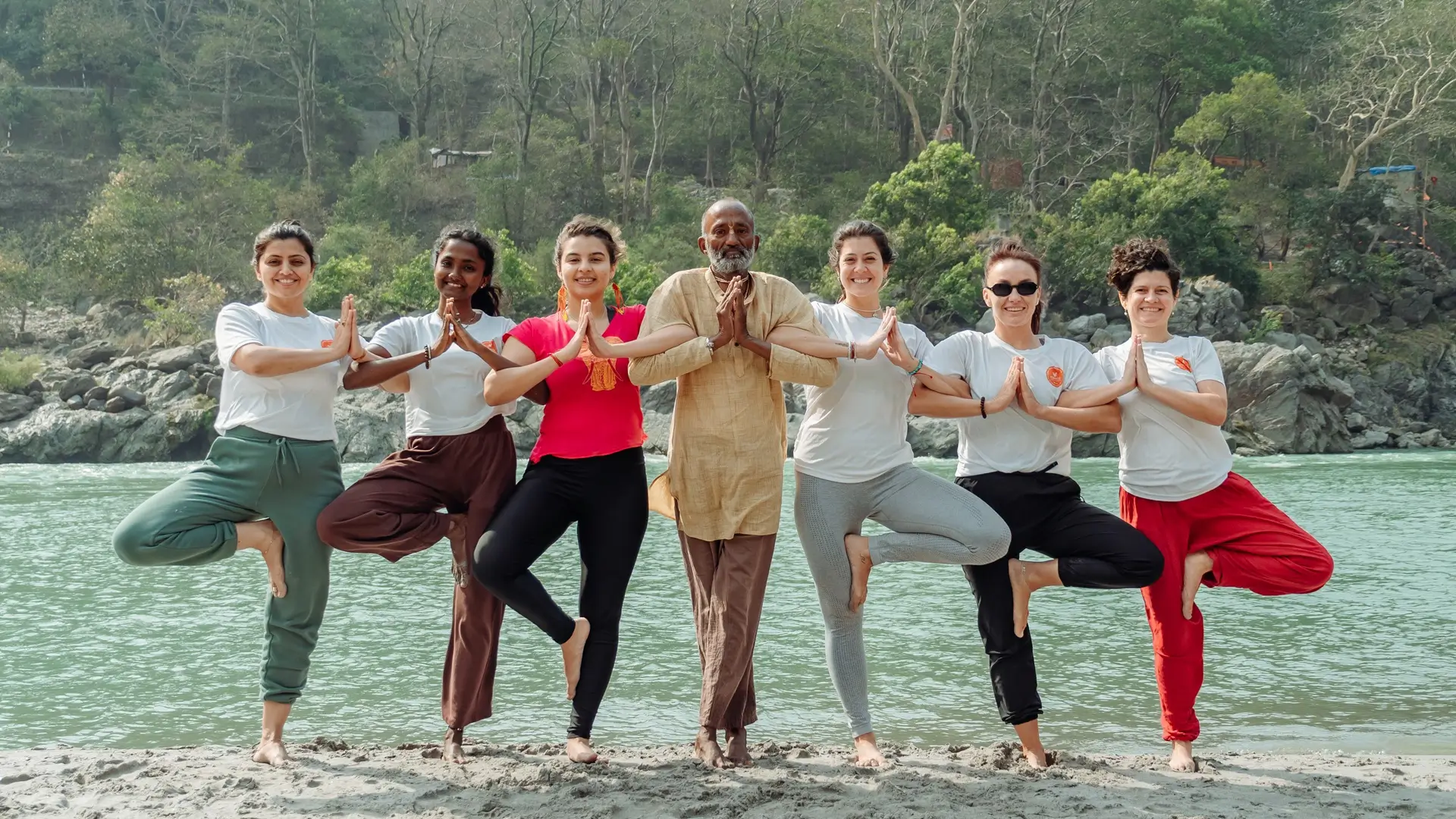
Once you have enrolled you do not need to worry about stay or food. We provide a clean, comfortable room and nutritious meals for the length of the course, in a location calm enough that a short week does not feel rushed.
Sattvic meals are served three times a day — fresh fruit, sprouts and fresh juice in the morning, and nutrient-rich vegetarian breakfast, lunch and dinner made with fresh vegetables. Our kitchen cooks the food a yogi eats, and cooks it well.
You choose an individual room or a twin shared one, whichever suits you. Every room has the essential amenities including free Wi-Fi, and enough space to sit, meditate and practise in without disruption.

Our campus sits in the quiet foothills of the Himalayas — open practice halls, a rooftop terrace to sit out on, and the hills in full view from sunrise to dusk. Close enough to the Ganga for a morning walk, far enough for the silence a practice needs.
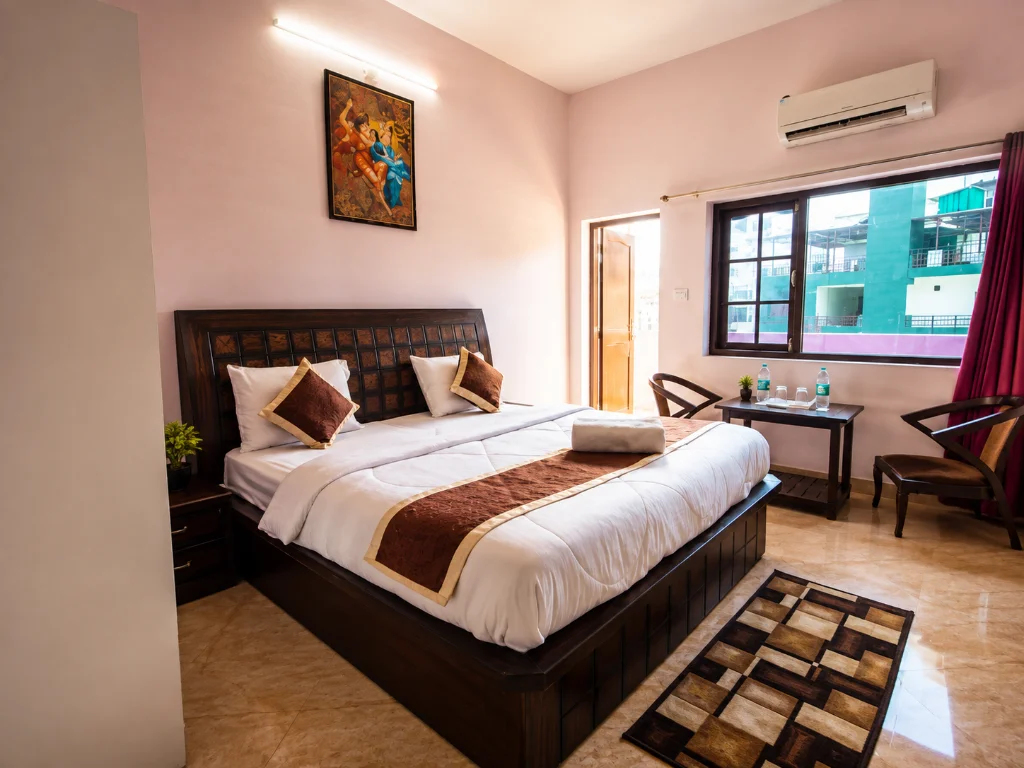
Clean, spacious rooms with an attached washroom and enough floor space to meditate or practise on your own. Housekeeping takes care of the rest, and you choose between a private or a shared room.

Three fresh vegetarian meals a day, along with seasonal fruits and herbal tea. Everything is cooked in the school kitchen and included in your course fee — no separate charges for food or stay.


 Ellen Silva
50 Hour Aerial Yoga TTC
Ellen Silva
50 Hour Aerial Yoga TTC
“After completing my TTC in September, I returned to the school, this time for another aerial yoga course, and I highly recommend it. I was received with great affection, attention, and professionalism. Without a doubt, it’s the best yoga school in Rishikesh.”
“I completed a 50-hour Aerial Yoga TTC, and the experience was truly amazing. Vimlesh Joshi sir was excellent—he explained everything clearly and in a very well-structured way. The sessions were thoughtfully designed, and his cues were precise and easy to follow. He made aerial yoga both fun and challenging at the same time, which kept us engaged throughout the training. Overall, it was a very positive and enriching experience for me.”
 Supratim Talukder Dance
50 Hour Aerial Yoga TTC
Supratim Talukder Dance
50 Hour Aerial Yoga TTC
“I completed Aerial Yoga course from Rishikesh Yog Kendra. It was amazing experience. Teachers are extremely efficient and beautiful ambience. Blissful community practice. I really appreciate. My gratitude to the institution. I recieved a lot’s of love and affection from my yoga buddies as well. Very beautiful experience. I really missed once I was leaving. Not ready to leave. Recommending you. Come and experience this beautiful journey. Sublime”
“Rishikesh Yog Kendra is truly a place filled with positive energy! The ashram has such peaceful and uplifting vibes that make you feel instantly at home. The satvik food was absolutely delicious – especially the khichdi, which became my favorite. Anil Sir and Neha Ma’am were amazing in the therapy classes, guiding with so much care and knowledge. Hitesh is without a doubt the best aerial yoga teacher, teaching each technique with patience and precision. Rahul Sir’s Vinyasa sessions were equally energizing and beautifully structured. I am so grateful for the experience and highly recommend this place to anyone seeking inner peace and authentic learning.”
 Ramya chakravarthy Artham
50 Hour Aerial Yoga TTC
Ramya chakravarthy Artham
50 Hour Aerial Yoga TTC
“My heart is with Rishikesh yog kendra My journey to Rishikesh was for the first time to learn Aerial yoga & i choosen this place for my course A warm welcome from Neha ji & our Gurus & yogesh ji every one makes us feel it’s just like home & we belong to one community that is yogam Learned loads of things & created so many memories I can say this is the best place to learn the subject in depth from the Knowledgeable Gurus like Vimlesh ji Soon will visit again to gain more knowledge from you all My Gratitude to each & every one who has made to learn so many things”
 Alejandra Guraieb
50 Hour Aerial Yoga TTC
Alejandra Guraieb
50 Hour Aerial Yoga TTC
“I just completed the 50-hour Aerial Yoga training at Rishikesh Yoga Kendra, and it was an incredible experience. The space is truly unique, set in a natural environment that feels open, peaceful, and inspiring. The teachers were professional, knowledgeable, and supportive throughout the entire training. The aerial yoga classes were not only fun and energizing but also deeply grounding. In my opinion, Yoga Kendra stands out from many other schools in Tapovan. It has a strong sense of community, and the overall atmosphere is warm and welcoming. If you’re in Rishikesh and want to dive into Aerial Yoga or explore something beyond the traditional settings, this is absolutely one of the most beautiful and worthwhile places to do.”
 Bonnie Lee
50 Hour Aerial Yoga TTC
Bonnie Lee
50 Hour Aerial Yoga TTC
“I attended aerial yoga class last month, it helped me to start a new sight of yoga on the hammock. Vimlesh ji has lots of passion on class, and he taught me lots of asans on the hammock. Not only asan, Neha ji also taught me relaxing sequences it helped me a lot for releasing my pain. And I’m also thankful for the teacher in morning meditation and practice. He helped us when we have question or want to more deep knowledge. I have digestion problem, when I change a little bit of environment I always have a stomachache, but here I never had that problem. I was so healthy so I could focus on my practice here. I also enjoyed special food: D For aerial yoga class I recommend this school, u can learn various asans here and can stay in yourself with healthy body and mind: D”
Ready to begin your own practice? Apply for a course.
 Hatha Yoga Pradipika
Download
Hatha Yoga Pradipika
Download
 The Gheranda Samhita
Download
The Gheranda Samhita
Download
 Inside the Yoga Sutras
Download
Inside the Yoga Sutras
Download
 Bhagavad Gita
Download
Bhagavad Gita
Download
 Raja Yoga
Download
Raja Yoga
Download
 The Royal Path
Download
The Royal Path
Download
 Yoga Anatomy
Download
Yoga Anatomy
Download
 Asana Pranayama Mudra Bandha
Download
Asana Pranayama Mudra Bandha
Download
 Ajna Chakra
Download
Ajna Chakra
Download
 Moola Bandha
Download
Moola Bandha
Download
 Prana and Pranayama
Download
Prana and Pranayama
Download
 Tattwa Shuddhi
Download
Tattwa Shuddhi
Download
 Path of Fire and Light
Download
Path of Fire and Light
Download
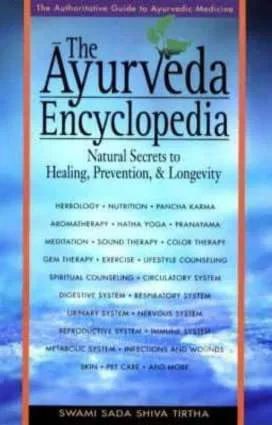 Ayurveda Encyclopedia
Download
Ayurveda Encyclopedia
Download
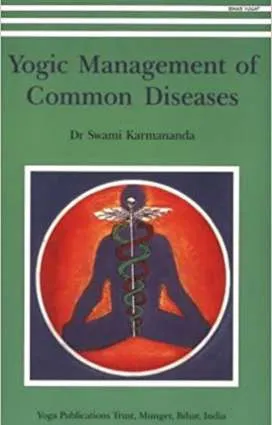 Yogic Management of Common Diseases
Download
Yogic Management of Common Diseases
Download
No. The 50 Hour Aerial Yoga Teacher Training is open to complete beginners, and many students arrive with no aerial background at all. The course starts with the fundamentals of working safely with the hammock and builds from there. If you already practise or teach yoga, Pilates, dance or fitness, that experience will help, but it is not required. What matters most is a willingness to practise carefully and to follow safety guidance.
No. You do not need to arrive strong or flexible, and Aerial Yoga is often more accessible than people expect, because the hammock supports part of your body weight. Strength and control develop naturally through daily practice across the week. Every posture can be approached at a level that suits you, and your teachers help you work within your own range rather than push beyond it.
Aerial Yoga is safe when it is taught and practised properly, and safety is treated as a first principle throughout this course. You learn how to check and set up the hammock, how the body should make contact with the fabric, and how to enter and leave each posture with control. Because groups are small and practice is closely supervised, mistakes are corrected early. Learning these habits well is exactly what makes the practice safe to do and, later, safe to teach.
You learn to teach. You certainly develop your own aerial practice, but a clear part of the course is given to teaching methodology: how to sequence a class, give safe and clear instructions, demonstrate, and adjust a student in the hammock. You also lead guided teaching sessions with your peers, so you finish the course having taught a class rather than only practised one.
The course suits a wide range of people. Yoga teachers, Pilates and fitness instructors, personal trainers, dancers, studio owners and other wellness professionals take it to add aerial work to their teaching. Dedicated practitioners join to broaden their own practice, and complete beginners are welcome too, since the training begins with the basics. It is taught in English and Hindi, so international students can follow every session.
Aerial hammocks and their fixings are designed to hold well above a typical person’s body weight, so most students never need to think about it. If you have a specific concern about weight, height or an injury, the best step is simply to tell us when you enquire, and we will give you honest, practical guidance before you book.
Wear fitted, comfortable clothing that covers the backs of the knees and the underarms, since these areas rest against the fabric in many postures. Avoid zips, buckles or rough jewellery that could catch or damage the hammock. The hammock and any props you need are provided, so you do not need your own equipment. Once your place is confirmed, we can share a simple list so you arrive well prepared.
Yes. On successful completion, you receive a Certificate of Completion from Rishikesh Yog Kendra, based on your participation through the week and a practical assessment of your aerial practice and teaching. It confirms that you are ready to teach Aerial Yoga safely and with confidence.
From Delhi to your mat in Tapovan — by air, rail, road or bus, here is every way students make their way to us.
Jolly Grant Airport, about 25 km from Rishikesh, has daily flights from Delhi. We can arrange a cab from the airport to the school for an additional fee.
Daily trains connect Delhi to Haridwar railway station. Once you arrive at Haridwar, we can organise a pickup for you at a reasonable charge.
We can also arrange a cab to bring you the whole way from Delhi to the school in Rishikesh, for a reasonable fee.
Buses run from Delhi to Rishikesh bus stand through the day. On arrival we can arrange a cab for the short hop to the school.
 Chat on WhatsApp

Fill the form below to begin your yoga journey




 What's Included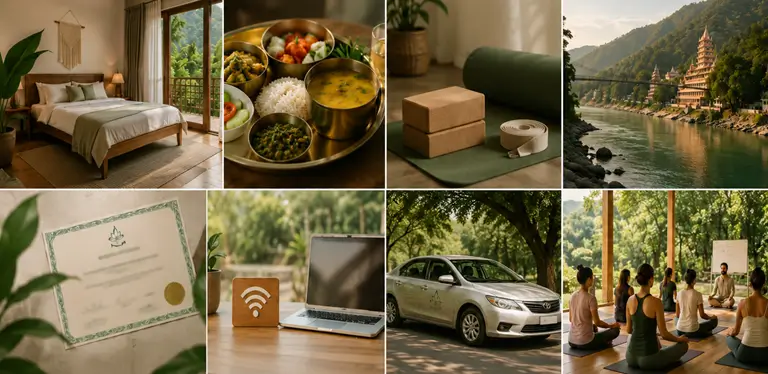


 & Campus Life